
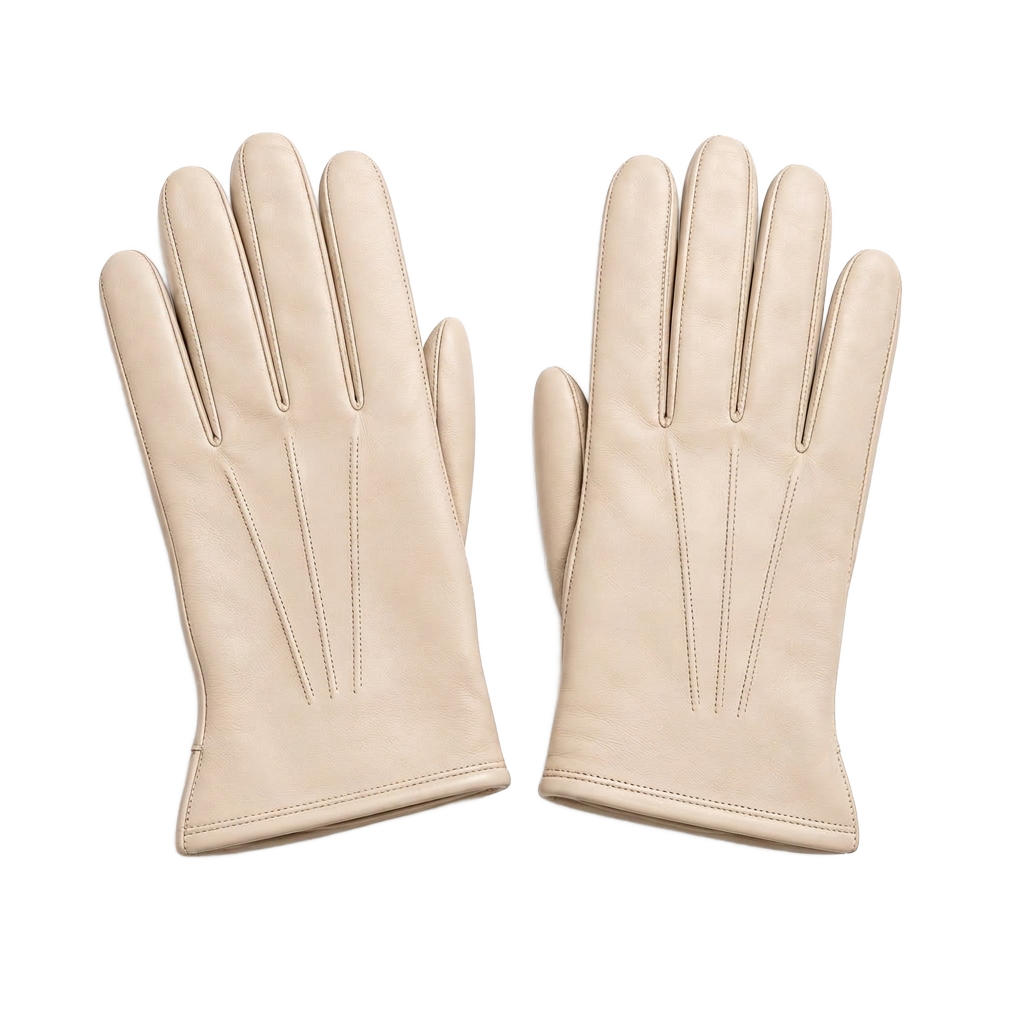
Leather Gloves
A pair of linen gloves was found in Tutankhamun's tomb, but the leather glove-making trade that still sets the technical standard today took shape centuries later in specific European towns — Grenoble in France and Yeovil in England both built entire local economies around the particular skill of cutting leather on the bias so a glove would stretch to the hand's shape without splitting at the seams. That single cutting technique, called tranking, is still what separates a well-made leather glove from a poorly made one.
The same factories that produce for houses like Celine and Balenciaga can produce this piece, directly to you
GABI
Make it yours
Material gradeMOQ 50
Colour
Leather Gloves
A pair of linen gloves was found in Tutankhamun's tomb, but the leather glove-making trade that still sets the technical standard today took shape centuries later in specific European towns — Grenoble in France and Yeovil in England both built entire local economies around the particular skill of cutting leather on the bias so a glove would stretch to the hand's shape without splitting at the seams. That single cutting technique, called tranking, is still what separates a well-made leather glove from a poorly made one.
The same factories that produce for houses like Celine and Balenciaga can produce this piece, directly to you
GABI
Make it yours
Material gradeMOQ 50
Colour
A pair of linen gloves was found in Tutankhamun's tomb, but the leather glove-making trade that still sets the technical standard today took shape centuries later in specific European towns — Grenoble in France and Yeovil in England both built entire local economies around the particular skill of cutting leather on the bias so a glove would stretch to the hand's shape without splitting at the seams. That single cutting technique, called tranking, is still what separates a well-made leather glove from a poorly made one.
The Bias Cut That Built an Industry
The history of tranking and the European towns that specialized in it.
Leather gloves require cutting along a bias pattern and stitching, whether by hand or machine, to achieve a structured fit; knitted gloves are machine-knitted in one piece on a glove-knitting machine, far faster and cheaper but without leather's shaped structure.
Fingerless gloves and wrist warmers skip finger separation almost entirely — usually a simple knit tube with a thumb opening — which is why they cost meaningfully less and knit faster than a full five-finger glove.
Touchscreen gloves are a targeted modification, not a different glove: conductive thread, usually silver or copper fiber, is blended into the yarn at the fingertip only, leaving the rest of the glove's construction unchanged.
FAQ
A knitted acrylic or wool glove (China, 300–500 unit run) lands around $2–4; a leather glove runs $12–25 depending on leather grade; adding touchscreen-conductive fingertips adds roughly $1–2 to either construction.
Leather gloves require bias-cut panels stitched together for a structured fit and cost significantly more; knitted gloves are machine-knitted in one continuous piece, far faster and cheaper to produce but with a looser, less structured fit.
Tranking is cutting the leather pattern at an angle to the hide's natural grain, which lets the finished glove stretch to the hand's shape without the seams splitting. A glove cut on the straight grain instead will fit stiffly and is more prone to seam failure.
Typically 300–500 pairs per size and colorway for knitted gloves; leather gloves often run higher, 500–1,000 pairs, since hide sourcing and cutting are done in larger batches to minimize waste.
Conductive fiber, usually silver- or copper-coated thread, is blended into the yarn at the fingertip during knitting so it conducts a touchscreen's capacitive signal. It's a targeted, low-cost addition — roughly $1–2 per pair — not a full glove redesign.
Fingerless gloves and wrist warmers skip finger separation entirely, usually knit as a simple tube with a thumb opening, which knits faster and uses less material than a full five-finger glove, meaningfully lowering unit cost.
Knitted gloves fall under HS 6116; leather gloves fall under HS 4203. Confirm per SKU based on primary material, since leather and textile gloves are classified under entirely different chapters.


