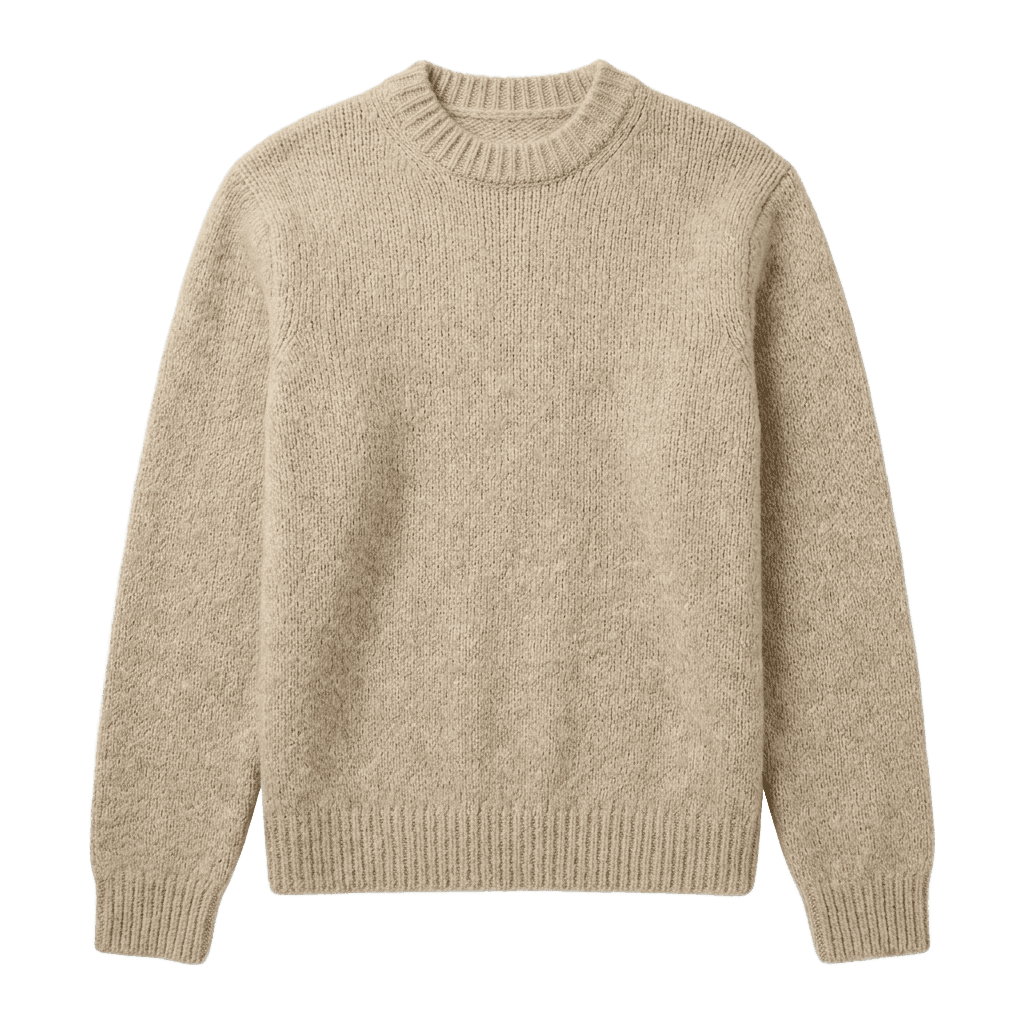
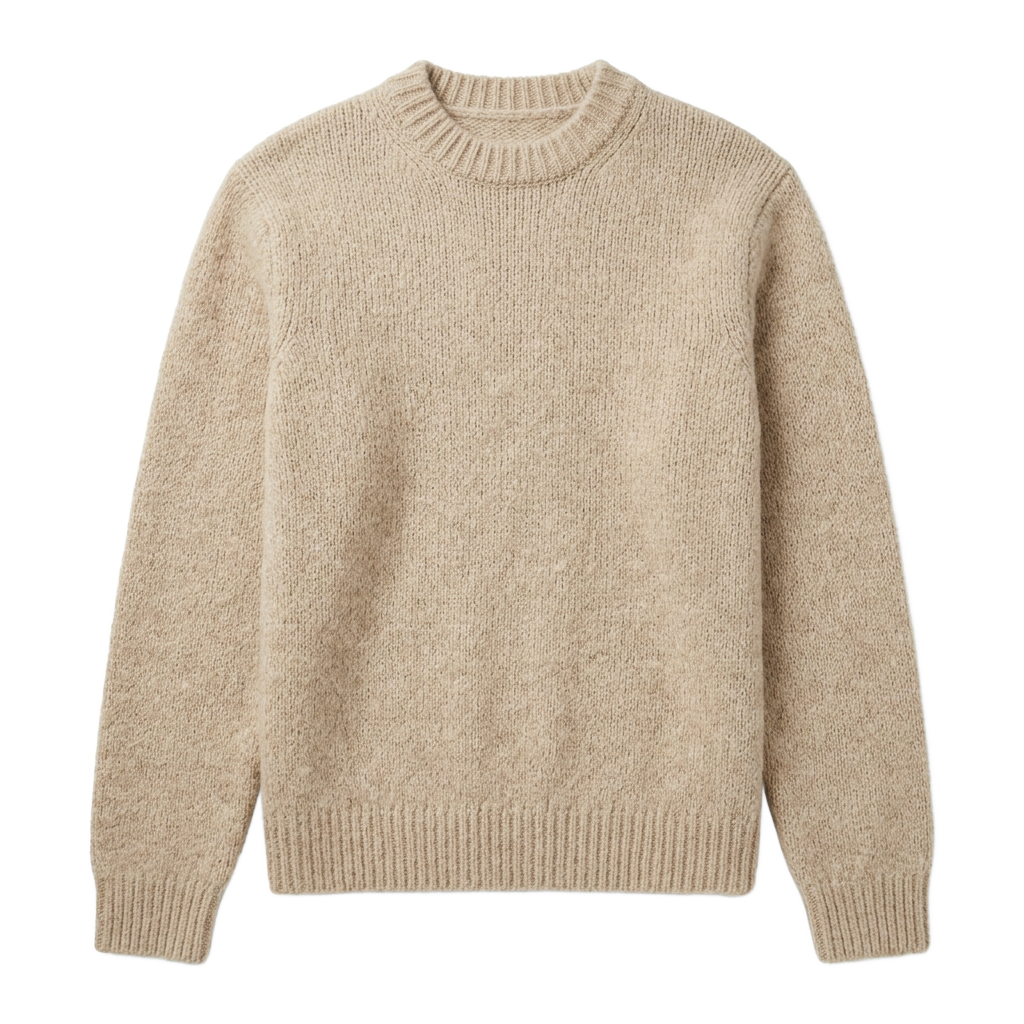
Beige Wool Sweater
@tspaarkd0105The same factories that produce for houses like Celine and Balenciaga can produce this piece, directly to you
GABI
Make it yours
Material gradeMOQ 100
Colour
Beige Wool Sweater
@tspaarkd0105The same factories that produce for houses like Celine and Balenciaga can produce this piece, directly to you
GABI
Make it yours
Material gradeMOQ 100
Colour
There are two ways to make a knit sweater. In the first, you buy fabric by the roll, cut out the panels like a woven shirt, and sew them together. Fast. Cheap. Wasteful. In the second, a flat-bed knitting machine knits the front panel exactly to shape. Then the back. Then each sleeve. No cutting. No waste. A linking operator joins the panels by hand with a single chain stitch. The linking seam is visible. It is not a flaw — it is the proof. That is a fully fashioned sweater. John Smedley has been making them this way since 1784.
The Crewneck Knit Sweater — "Two Methods, Two Worlds"
The knit sweater is one of the oldest manufactured garments in the commercial textile trade. Hand-knitting — the interlocking of loops of yarn by two needles to create a fabric that stretches in every direction — was documented in Europe from the 13th century, and the mechanisation of knitting through the invention of the stocking frame by William Lee in Nottingham in 1589 created the foundation of an industrial knitwear trade that persists to this day. The English East Midlands — Nottinghamshire, Leicestershire, Derbyshire — became the global centre of flat-bed knitting machine manufacture and operation, and that heritage runs directly from Lee's frame to the fully fashioned sweater factories of John Smedley, N.Peal, and Pringle of Scotland that operate today.
The crewneck is the canonical sweater silhouette — a round-neck pullover without collar, without placket, without button. It is defined by its absence of complication: fabric, construction, and yarn are the only variables. The crewneck became the standard commercial knitwear form in the early 20th century as machine knitting technology improved to the point where fully fashioned garments could be produced at commercial volume, and as the cultural authority of formal dress began to loosen sufficiently for knitwear to be acceptable outside of sport and leisure.
The history of sweater manufacturing is fundamentally a history of the tension between two production methods. Cut-and-sew knitwear — produced from rolls of circular or warp-knit fabric that are cut and assembled using woven garment sewing techniques — democratised the sweater by making it producible in any apparel factory with a serger and a lockstitch machine. Fully fashioned knitwear — produced on flat-bed Shima Seiki, Stoll, or Steiger machines that knit each panel to its precise finished dimensions — requires specialist machinery, specialist operators, and a production model that is slower, more capital-intensive, and more technically demanding than cut-and-sew. The result of fully fashioned production is a garment with no cutting waste, a cleaner silhouette, better shape retention over time, and a linking seam at the shoulder and armhole that is the most precise and distinctive quality signal in knitwear manufacturing.
The yarn is the defining material decision of sweater manufacturing. Cotton at affordable tier — typically a cotton/acrylic blend to reduce cost and improve washability — is the most commercially accessible specification. Lambswool and merino wool at premium tier provide the warmth, breathability, and handle that cotton cannot match. Cashmere — the fine undercoat fibre of the Capra hircus goat, combed rather than shorn — is the luxury standard, produced primarily in Mongolia and Inner China, with Scottish mills (Todd & Duncan, Dawson International) responsible for the most commercially significant processing and spinning. The Mongolian cashmere supply chain has been under significant sustainability pressure, with the Responsible Cashmere Standard (RCS) and the Sustainable Fibre Alliance (SFA) providing certification frameworks.
Gauge — the number of stitches per inch in the knit structure — is the primary determinant of fabric weight and character. Fine gauge (12–16 gauge) produces a smooth, close-knit fabric appropriate for luxury and suiting-adjacent knitwear. Mid gauge (7–10 gauge) is the commercial standard for the sweater market. Chunky gauge (3–5 gauge) produces the thick, textured knit associated with Aran and fisherman sweaters. The choice of gauge determines the knitting machine required, the yarn count appropriate, and the finished garment weight.
Stitch structure adds the third dimension of differentiation. Plain jersey (the most basic knit structure) produces a smooth face and a visible loop reverse. Ribbed structures — 1×1, 2×2 — add texture and stretch. Cable stitch creates the raised twisted-rope pattern associated with Aran sweaters. Jacquard knitting allows colour patterns to be knitted into the fabric rather than printed or embroidered on top — Fair Isle and Nordic patterns are the canonical examples. Each stitch structure requires specific machine capabilities and adds to the production time and CMT.
For independent creators, the sweater is one of the most rewarding garment categories in the Sparkit Encyclopedia — and one of the most technically demanding to specify correctly. The cut-and-sew route offers accessible entry at lower MOQ and cost. The fully fashioned route offers brand credibility, quality signals, and a retail price architecture that can reach $400–800 for cashmere. Both require yarn sourcing knowledge, gauge understanding, and a factory relationship that goes beyond standard CMT.
FAQ
A crewneck knit sweater costs between $21 and $88 per unit landed. Affordable cotton/acrylic cut-and-sew from China: ~$21. Premium ZQ Merino fully fashioned from Portugal: ~$48. Luxury Grade A cashmere fine gauge fully fashioned from Scotland or Italy: ~$88. The primary cost drivers are yarn fibre (cotton/acrylic $5.50/kg vs cashmere $115/kg) and production method (cut-and-sew CMT $10 vs fully fashioned $22–34).
Cut-and-sew sweaters are produced from rolls of circular knit fabric, cut to pattern shapes and assembled using conventional sewing machines — the same process used for T-shirts and sweatshirts. Fully fashioned sweaters are produced on flat-bed knitting machines (Shima Seiki, Stoll) that knit each panel — front, back, sleeves — to its precise finished shape. There is no cutting and therefore no fabric waste. The panels are joined by a linking operator using a chain stitch that creates a visible, deliberate seam at the shoulder and armhole. This linking seam is the primary quality signal of fully fashioned knitwear.
Gauge (GG) is the number of stitches per inch in a knit fabric — the higher the gauge, the finer and more closely knit the fabric. Fine gauge (12–16 GG) produces a smooth, lightweight fabric for luxury and suiting-adjacent positioning — cashmere and superfine merino. Mid gauge (7–10 GG) is the commercial standard for most sweaters — lambswool, merino, and cotton. Chunky gauge (3–5 GG) produces the thick, textured knit of Aran and heritage sweaters. Gauge determines the knitting machine, the appropriate yarn count, and the finished garment weight.
ZQ Merino (≤18.5 micron) at mid gauge is the most commercially credible premium specification — soft against skin, certified, traceable, and available from New Zealand-origin mills. Lambswool is a strong alternative at lower cost with a springier, more characterful handle. For cashmere entry positioning, a 70/30 cashmere/merino blend gives the cashmere handle at significantly lower yarn cost than 100% cashmere. Specify yarn by fibre content, micron count, yarn count (Nm), and certification.
A linking seam joins two knit panels by threading each stitch loop of both panels onto a circular linking machine and closing them with a single chain stitch. The result is a flat, clean seam in which every stitch is individually captured — no bulk, no overlap, no raw edge. The linking seam is visible on the right side of a fully fashioned garment as a fine raised line at the shoulder and armhole. It is the most precise manufacturing signal in knitwear and the defining difference between premium and luxury sweater construction. A linking seam cannot be faked on a sewing machine — it requires a linking machine and a trained linking operator.
For merino: ZQ (×1.12–1.18) for the highest animal welfare and traceability standard, or RWS (×1.08–1.12) as the widely available alternative. For lambswool: RWS. For cashmere: RCS or SFA (×1.10–1.15). For cotton: GOTS (×1.23). OEKO-TEX STANDARD 100 is the baseline consumer safety credential across all fibres. The most commercially compelling combination for premium sustainable positioning is ZQ Merino or RCS cashmere + OEKO-TEX.
HS code 6110 covers jerseys, pullovers, sweatshirts, waistcoats, and similar articles of knit or crocheted fabric. This applies to all crewneck knit sweaters regardless of fibre content. Note that HS 6110 also covers the hoodie and sweatshirt — the classification is based on knit construction, not garment type.
China: dominant for all methods, all fibres, all gauges — the most accessible. Portugal: strong for fully fashioned at premium tier with Made in Europe positioning. Scotland (Hawick, Selkirk): the global benchmark for luxury fully fashioned knitwear in merino, lambswool, and cashmere. Italy (Carpi, Prato): luxury fully fashioned, particularly for fine gauge cashmere and merino. Mongolia: source-country advantage for cashmere, growing FF capability.
Benchmarked at size M: chunky gauge (3–5 GG) 400–600g per unit. Mid gauge (7–10 GG) 250–400g. Fine gauge (12–16 GG) 150–250g. Yarn cost per unit = consumption (g) ÷ 1,000 × yarn price (per kg). For Grade A cashmere at $115/kg with 200g consumption: $23.00 yarn cost per unit before certification multiplier.
Pilling is the formation of small fibre balls on the fabric surface caused by loose fibres tangling under friction. It is the most common quality complaint in knitwear. Prevention: specify long-staple or combed yarn (longer fibres pill less than short-fibre or carded yarn). Specify minimum yarn twist (tighter twist = more durable surface). Avoid acrylic above 30% in blends. Request Martindale pilling test with minimum pass threshold: ≥3,000 cycles at affordable, ≥10,000 at premium.
Yes. A kangaroo pocket (like a hoodie) is a cut-and-sew addition — a knit pocket piece sewn to the front body post-knitting. It adds $2–4/unit CMT. A chest welt pocket adds $3–5/unit. Patch pockets add $2–3/unit. Fully fashioned sweaters rarely carry pockets — the pocket is typically cut-and-sew addition even on FF garments. Specify pocket separately from the body construction.
Lambswool is the first fleece shorn from a sheep before its first birthday — it is finer and softer than subsequent shearings. Merino wool comes from the Merino breed, which produces naturally finer-diameter fibre than most other breeds: 17–25 micron versus 28–35 micron for generic wool. Superfine merino (≤18.5 micron) is soft enough to wear against skin without irritation. Lambswool and merino can overlap in quality at their best grades — Scottish mill lambswool (Todd & Duncan) and ZQ Merino are both premium benchmarks at comparable price points.