
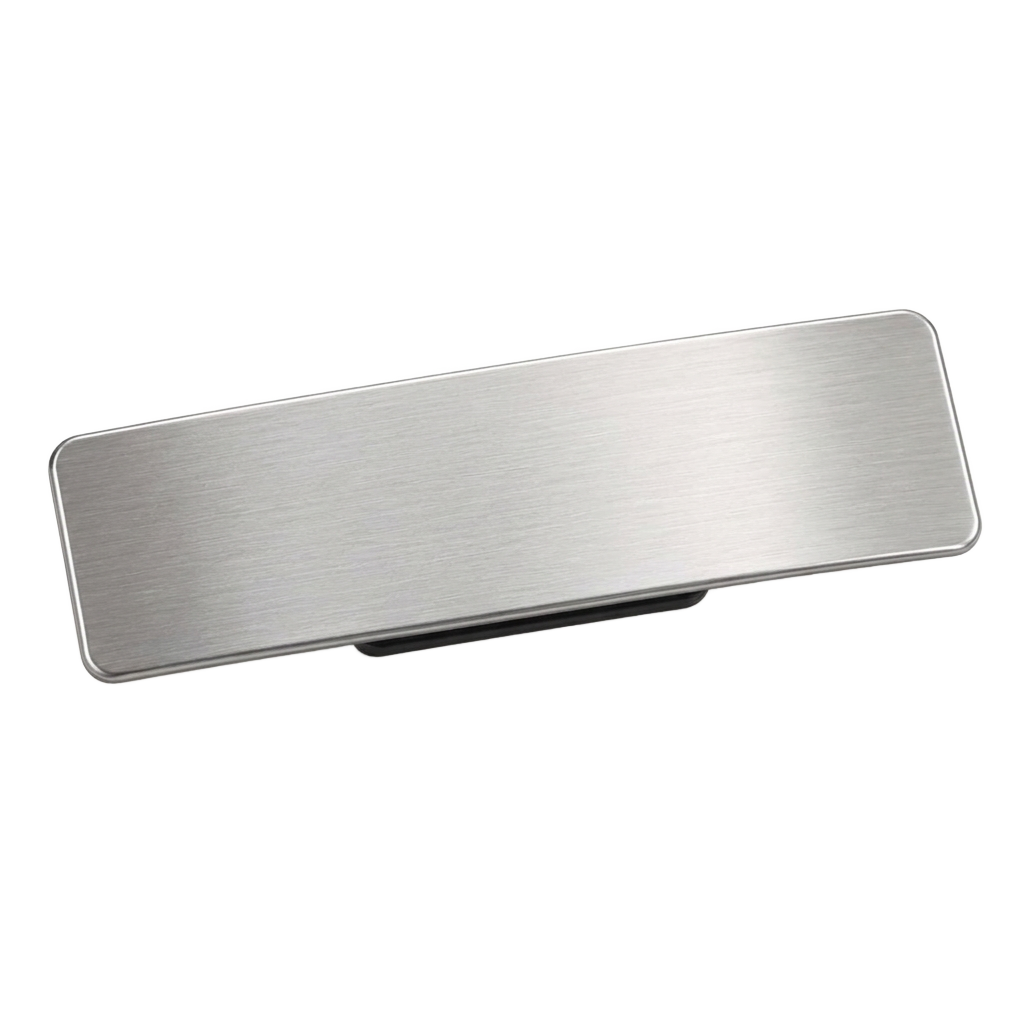
Metal Name Badge
Long before a lanyard held anyone's office ID badge, a sailor's lanyard held a gunner's fid or a boarding pistol's trigger, tethered so it wouldn't go over the side in a rolling sea. The word comes from the French lanière, a strap or thong, and for centuries it meant exactly one thing: a cord that keeps something you can't afford to lose attached to your body. The corporate ID lanyard, standard issue at every conference and office building today, is a direct descendant of that shipboard habit — the object changed, but the job stayed the same.
The same factories that produce for houses like Celine and Balenciaga can produce this piece, directly to you
GABI
Make it yours
Material gradeMOQ 50
Colour
Metal Name Badge
Long before a lanyard held anyone's office ID badge, a sailor's lanyard held a gunner's fid or a boarding pistol's trigger, tethered so it wouldn't go over the side in a rolling sea. The word comes from the French lanière, a strap or thong, and for centuries it meant exactly one thing: a cord that keeps something you can't afford to lose attached to your body. The corporate ID lanyard, standard issue at every conference and office building today, is a direct descendant of that shipboard habit — the object changed, but the job stayed the same.
The same factories that produce for houses like Celine and Balenciaga can produce this piece, directly to you
GABI
Make it yours
Material gradeMOQ 50
Colour
Long before a lanyard held anyone's office ID badge, a sailor's lanyard held a gunner's fid or a boarding pistol's trigger, tethered so it wouldn't go over the side in a rolling sea. The word comes from the French lanière, a strap or thong, and for centuries it meant exactly one thing: a cord that keeps something you can't afford to lose attached to your body. The corporate ID lanyard, standard issue at every conference and office building today, is a direct descendant of that shipboard habit — the object changed, but the job stayed the same.
From Ship's Deck to Conference Badge
Military and ceremonial lanyards (the woven shoulder cords still seen on dress uniforms) are the formal branch of the same lineage, descended from cavalry cords used to secure a sidearm or whistle. The corporate ID lanyard boomed later, through the 1990s and 2000s, as office security and conference badging became standard practice.
Flat woven polyester lanyards split into two production methods: jacquard-woven, where the logo is woven directly into the strap on the loom using colored threads, and printed or dye-sublimated, where the graphic is applied to a plain woven strap afterward. Woven logos cost more upfront but never fade or crack; printed graphics are cheaper and faster to produce but degrade with heat and washing over time.
Retractable badge reels use the same spring-loaded reel mechanism as a tape measure, adapted into a smaller housing. Metal housings cost more but tolerate far more retraction cycles before the spring or cord wears out; plastic housings are the standard for lower-cost, higher-volume event badging where the reel isn't expected to survive years of daily use.
Enamel lapel pins split into hard and soft enamel. Hard enamel pins are die-struck, then filled and polished flush so the surface is smooth and scratch-resistant; soft enamel pins are filled but left unpolished, leaving the metal outlines slightly raised and the color recessed. Hard enamel costs more and holds detail and durability better; soft enamel is faster and cheaper to produce.
FAQ
A standard printed polyester lanyard (China, 500-unit run) lands around $0.80–1.50; a jacquard-woven lanyard with the logo built into the weave runs $1.50–3, driven by loom setup and thread-color changes; a leather lanyard or card holder runs $4–10 depending on leather grade.
Woven (jacquard) is worth it for a logo that needs to survive years of daily wear without fading — it costs more upfront but needs no reprinting. Printed or dye-sublimated is fine for one-off events or short campaigns where the lanyard has a shelf life of months, not years.
Typically 300–500 units per design, since both jacquard looms and screen-printing setups have a fixed setup cost per pattern that only amortizes at volume; below that, a simpler single-color print on a stock lanyard is far more cost-effective than custom weaving.
Both use a coiled-spring reel mechanism, the same principle as a tape measure, housed in a case that clips to clothing. Metal housings cost more but withstand many more retraction cycles before the spring fatigues; plastic housings are standard for lower-cost event badges not expected to survive daily long-term use.
Hard enamel pins are die-struck, filled with enamel, then polished flush so the surface is smooth and scratch-resistant — more durable and a higher unit cost. Soft enamel pins are filled but left unpolished, so the metal lines sit slightly raised and the enamel recessed — faster and cheaper to produce, with a textured feel.
For workplace and event use, yes — most corporate and event lanyard specs now include a breakaway connector near the neck that releases under sudden pressure, reducing strangulation risk if the lanyard gets caught on equipment. It's a standard, low-cost add-on that should be specified explicitly if not already included.
Textile lanyards typically fall under HS 5808 (braids and trimmings) or HS 6307 (other made-up textile articles) depending on construction; metal lapel pins fall under HS 7117 (imitation jewelry) or HS 8308 depending on function. Confirm per SKU, since material and construction — not just "lanyard" as a category — determine the code.


