
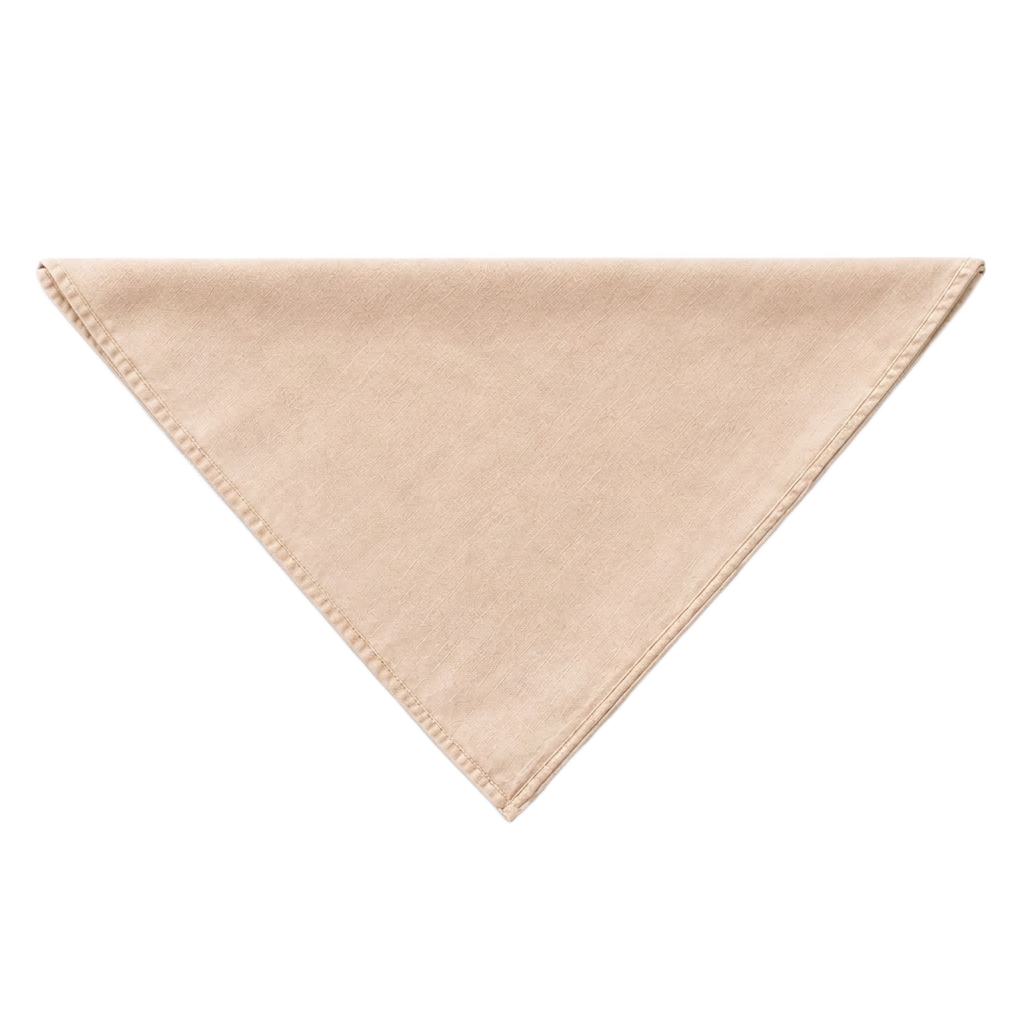
Bandana / Neckerchief
The word "bandana" comes from the Hindi bandhnu, a tie-dye technique, and the paisley pattern printed on most of them today traces back to Kashmir shawl motifs that European trade brought west in the 18th century. The neck gaiter sitting next to it in a product line has almost no shared history — it's a 1990s Spanish outdoor-gear invention, a seamless tube of stretch fabric with no ties, hems, or pattern tradition behind it at all. They solve a similar problem, covering the neck and face, from two completely different manufacturing traditions.
The same factories that produce for houses like Celine and Balenciaga can produce this piece, directly to you
GABI
Make it yours
Material gradeMOQ 50
Colour
Bandana / Neckerchief
The word "bandana" comes from the Hindi bandhnu, a tie-dye technique, and the paisley pattern printed on most of them today traces back to Kashmir shawl motifs that European trade brought west in the 18th century. The neck gaiter sitting next to it in a product line has almost no shared history — it's a 1990s Spanish outdoor-gear invention, a seamless tube of stretch fabric with no ties, hems, or pattern tradition behind it at all. They solve a similar problem, covering the neck and face, from two completely different manufacturing traditions.
The same factories that produce for houses like Celine and Balenciaga can produce this piece, directly to you
GABI
Make it yours
Material gradeMOQ 50
Colour
The word "bandana" comes from the Hindi bandhnu, a tie-dye technique, and the paisley pattern printed on most of them today traces back to Kashmir shawl motifs that European trade brought west in the 18th century. The neck gaiter sitting next to it in a product line has almost no shared history — it's a 1990s Spanish outdoor-gear invention, a seamless tube of stretch fabric with no ties, hems, or pattern tradition behind it at all. They solve a similar problem, covering the neck and face, from two completely different manufacturing traditions.
Two Traditions, One Job
The bandana's roots in Indian tie-dye and Kashmir paisley motifs versus the neck gaiter's much newer, purely technical origin.
A bandana is a square of woven cotton, typically pattern-printed via rotary screen printing rather than woven-in, and hemmed on all four edges — a flat, foldable, multi-use piece of fabric.
A neck gaiter is knitted as a seamless tube with no side seams at all, typically in polyester microfiber for stretch and moisture-wicking, a fundamentally different construction from a cut-and-sewn flat panel.
Both are marketed on multi-functionality (face covering, headband, wristband, neck warmer), which shapes sizing toward a looser, more universal fit than a single-purpose garment would need.
FAQ
A printed cotton bandana (China, 500-unit run) lands around $1–2; a polyester microfiber neck gaiter runs $2–4, driven by the seamless circular knitting process.
A bandana is a flat, hemmed square of woven cotton, usually printed; a neck gaiter is knitted as a seamless tube with no side seams at all, a fundamentally different manufacturing process, not just a different shape.
Printed (rotary screen printing) is the standard and far cheaper option; a woven-in pattern is technically possible but rarely used for bandanas since the flat cotton weave doesn't lend itself to jacquard patterning the way a knit scarf does.
Typically 500–1,000 units per design, since screen printing setup for a bandana and circular knitting setup for a gaiter both carry a fixed cost per pattern that needs volume to amortize.
Polyester or polyester-spandex microfiber is standard, chosen for stretch recovery and quick-dry performance; specify the blend ratio, since higher spandex content improves stretch but can reduce wicking speed slightly.
Yes — since both are marketed for several uses (face covering, headband, wristband), they're typically designed with a looser, more universal fit rather than sized precisely for one use, which should be reflected in the pattern dimensions.
Bandanas generally fall under HS 6214 (scarves and similar articles); neck gaiters, being knitted tubular garments, may fall under a different subheading depending on classification as apparel or an accessory. Confirm per SKU with a customs broker, as this is a category with some classification ambiguity.

