
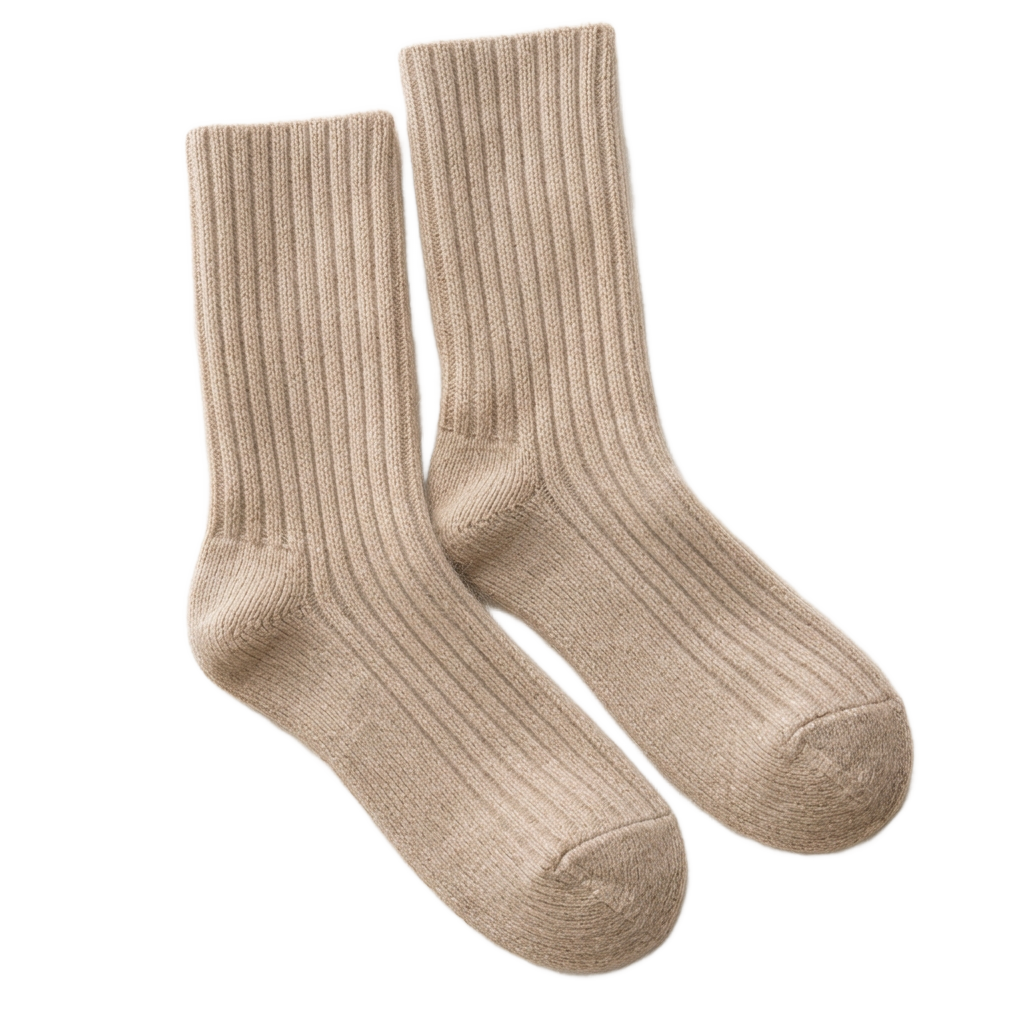
Cashmere Lounge Socks
In 1589, an English curate named William Lee built a machine that could knit a stocking in a fraction of the time it took by hand, and brought it to Queen Elizabeth I hoping for a patent. She refused him — reportedly because the machine only worked in coarse wool and she wanted her stockings in silk — and Lee died in France still chasing a patent that never came. His stocking frame became the direct ancestor of the circular knitting machine that still produces nearly every sock made today, patent or no patent.
The same factories that produce for houses like Celine and Balenciaga can produce this piece, directly to you
GABI
Make it yours
Material gradeMOQ 50
Colour
Cashmere Lounge Socks
In 1589, an English curate named William Lee built a machine that could knit a stocking in a fraction of the time it took by hand, and brought it to Queen Elizabeth I hoping for a patent. She refused him — reportedly because the machine only worked in coarse wool and she wanted her stockings in silk — and Lee died in France still chasing a patent that never came. His stocking frame became the direct ancestor of the circular knitting machine that still produces nearly every sock made today, patent or no patent.
The same factories that produce for houses like Celine and Balenciaga can produce this piece, directly to you
GABI
Make it yours
Material gradeMOQ 50
Colour
In 1589, an English curate named William Lee built a machine that could knit a stocking in a fraction of the time it took by hand, and brought it to Queen Elizabeth I hoping for a patent. She refused him — reportedly because the machine only worked in coarse wool and she wanted her stockings in silk — and Lee died in France still chasing a patent that never came. His stocking frame became the direct ancestor of the circular knitting machine that still produces nearly every sock made today, patent or no patent.
The Stocking Frame's Slow Revenge
Lee's hand-cranked frame was refined over two centuries into the powered circular knitting machine, which by the 19th century had turned hosiery from a hand craft into an industrial one, centered in England's East Midlands. That same circular-knit principle, needles arranged in a cylinder, is still exactly how a factory line turns a cone of yarn into a finished sock today.
Fiber choice is the main cost and performance lever. Cotton is cheap and breathable but holds moisture; merino wool costs more but regulates temperature and resists odor even after multiple wears, which is why it dominates hiking and ski socks; cashmere is the softest option but too fragile to wear alone, so lounge socks blend it with nylon for strength.
Reinforced heels and toes are double-knit — an extra layer of yarn looped into just the high-friction zones — adding a small material cost in exchange for meaningfully longer wear life. Ribbed cuffs use an elastic knit structure to keep a sock from sliding down without needing separate elastic thread sewn in afterward.
Grip socks are one of the newer entries in the category, driven less by athletic performance and more by studio hygiene rules — many pilates and yoga studios now require closed-toe, non-slip socks on shared equipment. The silicone dots are screen-printed onto the sole after knitting, a separate finishing step that a plain sock skips entirely.
FAQ
Knitted hosiery generally falls under HS 6115, with subheadings splitting by fiber content (cotton, synthetic, wool) and by whether the item is graduated compression hosiery. Confirm the specific subheading per fiber blend, since duty rates vary by material.
A standard cotton crew sock (China, 500-unit run per size/colorway) lands around $1.50–3; merino wool runs $4–7 per pair driven by fiber cost; cashmere-blend lounge socks run $6–10, driven by the cashmere content percentage.
Cotton is the cheapest and most breathable but holds moisture and can feel damp on long wears; merino wool costs more but wicks moisture and resists odor even after repeated wear, making it the standard for hiking and ski socks; cashmere is the softest but least durable, so it's almost always blended with nylon rather than used alone.
Typically 300–500 pairs per size and colorway combination, since circular knitting machines need a changeover for each pattern and yarn color, and that changeover cost is what the minimum is covering, not the yarn itself.
They start as a standard knit sock, then go through a separate finishing step where silicone is screen-printed onto the sole in a dot or strip pattern and cured. This adds a production step and cost over a plain sock, so confirm grip placement and density (how much silicone coverage) in the spec.
It's an extra layer of yarn double-knitted into just the heel and toe during production, adding modest cost in exchange for meaningfully longer wear life in those high-friction zones. Worth specifying for athletic or hiking socks; less necessary for dress or lounge socks with lighter use.
Medical-grade graduated compression (used for circulation conditions) requires clinical-grade manufacturing and sometimes regulatory classification depending on the market; athletic "compression" socks sold for recreational use don't require certification but should avoid medical claims unless the compression level has been independently tested.


