
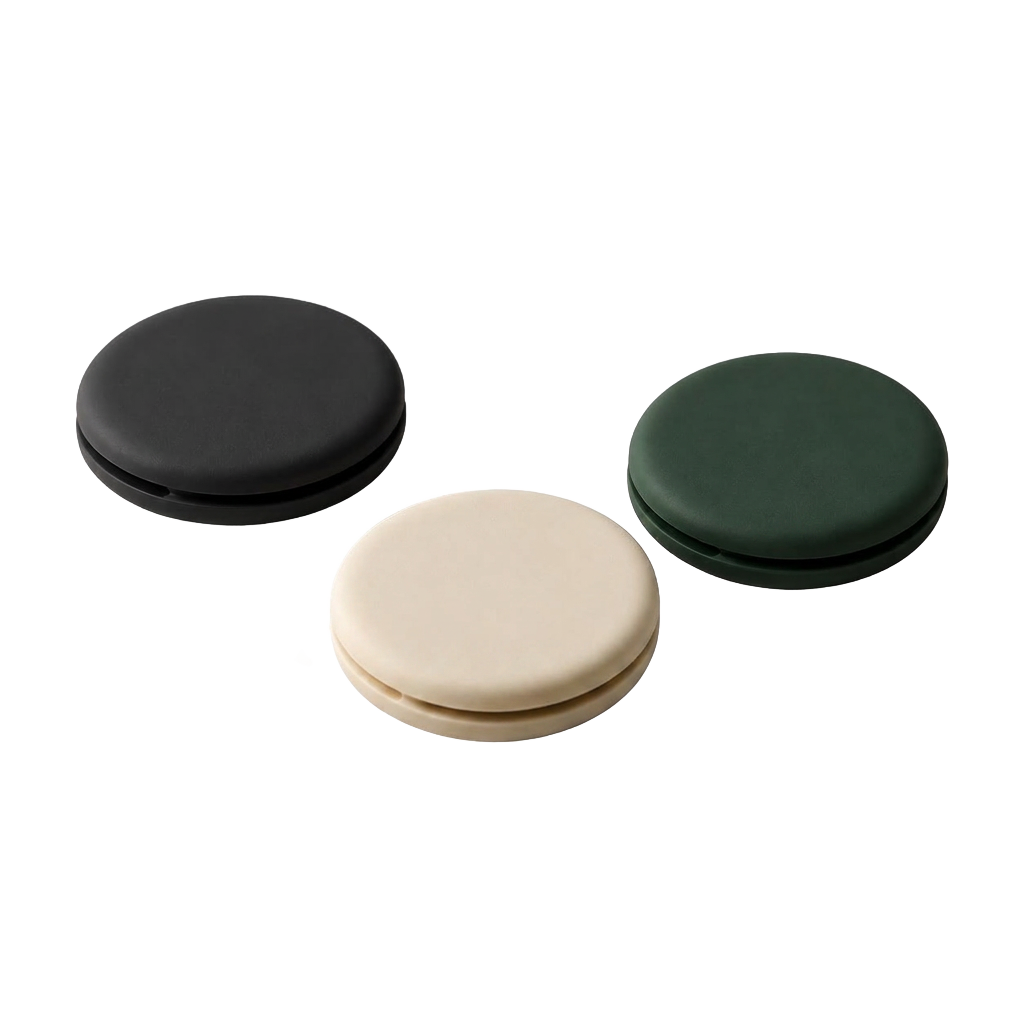
Tennis Vibration Dampener
In 1972, tennis balls turned yellow. Not for players — for television. Wimbledon held out in white until 1986, the last major tournament to convert, because tradition mattered more there than visibility on a screen. Everywhere else, color followed the camera. It's a pattern that repeats through the sport's equipment history: rules bend to whatever technology makes the game more watchable, more playable, or more exportable — from a French monastery courtyard game to a global hard-court industry.
The same factories that produce for houses like Celine and Balenciaga can produce this piece, directly to you
GABI
Make it yours
Material gradeMOQ 50
Colour
Tennis Vibration Dampener
In 1972, tennis balls turned yellow. Not for players — for television. Wimbledon held out in white until 1986, the last major tournament to convert, because tradition mattered more there than visibility on a screen. Everywhere else, color followed the camera. It's a pattern that repeats through the sport's equipment history: rules bend to whatever technology makes the game more watchable, more playable, or more exportable — from a French monastery courtyard game to a global hard-court industry.
The same factories that produce for houses like Celine and Balenciaga can produce this piece, directly to you
GABI
Make it yours
Material gradeMOQ 50
Colour
In 1972, tennis balls turned yellow. Not for players — for television. Wimbledon held out in white until 1986, the last major tournament to convert, because tradition mattered more there than visibility on a screen. Everywhere else, color followed the camera. It's a pattern that repeats through the sport's equipment history: rules bend to whatever technology makes the game more watchable, more playable, or more exportable — from a French monastery courtyard game to a global hard-court industry.
From the Cloister to the Court
Tennis descends from jeu de paume ("game of the palm"), played in French monastery courtyards from the 12th century, where players struck a ball with a bare or gloved hand across a rope. Rackets were added by the 16th century, and the game was popular enough among French nobility that Louis X reportedly died in 1316 after playing an intense match and drinking chilled wine — one of history's earliest recorded sports injuries.
Modern lawn tennis was codified far later and far more deliberately: Major Walter Clopton Wingfield patented a boxed set called "Sphairistike" in 1874, complete with net, rackets, balls, and an hourglass court marking guide, intended for lawn parties. The All England Croquet Club hosted the first Wimbledon Championship in 1877, borrowing Wingfield's rules almost wholesale and giving the modern sport its first permanent home and its enduring grass-court identity.
Racket materials moved from solid wood (standard through the 1960s) to laminated wood, then to steel (Wilson's T2000, 1967), and finally to composite fiberglass and graphite frames through the 1970s and 80s. The most consequential shift wasn't material but shape: Howard Head's Prince oversized racket (1976) nearly doubled the hitting area of a standard wood frame, and by the mid-1980s virtually no professional played wood.
Ball construction has stayed comparatively stable — a vulcanized rubber core covered in a wool-nylon felt — but felt formulation and pressurization are precisely regulated by the ITF, since the same rubber-and-felt principle must perform identically on clay, grass, and hard courts at sea level and altitude. Manufacturers produce distinct ball specifications for different surfaces and altitudes, a detail most recreational buyers never see on the can.
FAQ
A pressurized 3-ball tube (China, large-volume run) lands around $2–4; the felt (wool-nylon blend) and precise rubber core vulcanization are the main cost drivers, and pressurized cans add packaging cost that pressureless balls (used for practice/ball machines) avoid.
Composite rackets require a specialized frame factory with autoclave or compression-molding equipment for the graphite/fiberglass layup — a general sporting goods factory cannot produce a structurally reliable frame. Stringing, grip wrapping, and cosmetic finishing can be done at a separate facility from frame molding.
Realistically 500–1,000 units per mold, since frame tooling (the mold itself) is the dominant upfront cost and only amortizes at volume; below that, sourcing from an existing mold library with custom paint/graphics is far more viable than a bespoke frame shape.
Only for sanctioned competition use. Recreational balls can be sold without ITF approval, but "ITF approved" claims require the specific ball to be on the ITF's official list, which involves bounce, compression, and size testing the manufacturer must commission separately.
A single-racket cover is a close-fitting sleeve with minimal padding, sized to the racket head shape; a multi-racket bag adds a rigid or semi-rigid shell, thermal lining (rackets are heat-sensitive), and separate compartments for balls and accessories — meaningfully more construction and material cost per unit.
Overgrips are typically PU or synthetic microfiber with a perforated or textured surface for tack; specify thickness (standard is ~0.6mm) and tackiness level, since "grip tape" alone doesn't distinguish between a dry, cushioned, or tacky finish — each targets a different player preference.
Air density affects ball flight; balls made for high-altitude play use lower internal pressure to compensate for thinner air, and surface-specific felt formulations (heavier-duty felt for clay, which is more abrasive) exist because a single ball spec doesn't perform consistently everywhere — this is a genuine technical spec to confirm, not a marketing distinction.


