
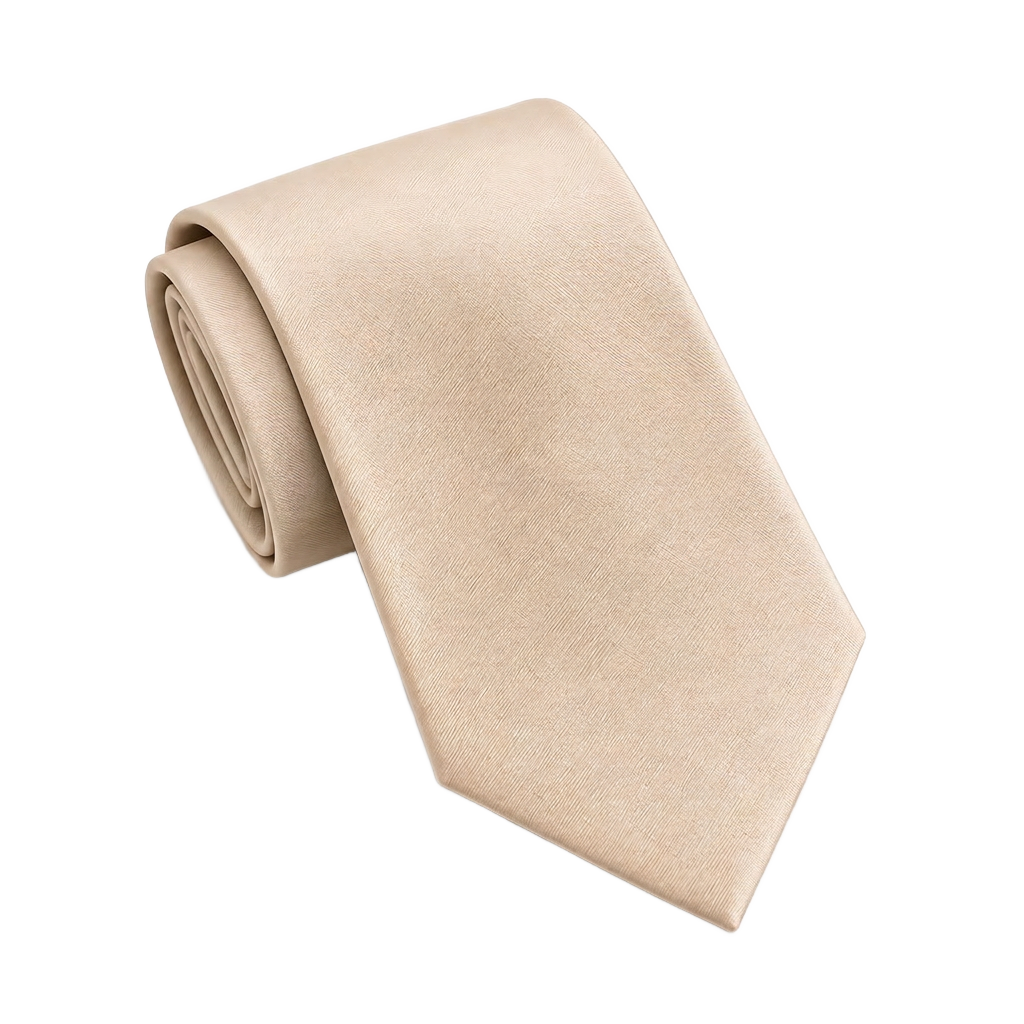
Tie
In the 1630s, Croatian mercenaries fighting in France wore a knotted cloth around the neck as part of their military dress. French soldiers liked the look enough to adopt it themselves, and named it la cravate — a corruption of "Croate." Three centuries of refinement turned that knotted cloth into the necktie, cut on the bias so it would hang straight and resist twisting, a tailoring detail invented specifically to solve a problem cravats didn't have to deal with.
The same factories that produce for houses like Celine and Balenciaga can produce this piece, directly to you
GABI
Make it yours
Material gradeMOQ 50
Colour
Tie
In the 1630s, Croatian mercenaries fighting in France wore a knotted cloth around the neck as part of their military dress. French soldiers liked the look enough to adopt it themselves, and named it la cravate — a corruption of "Croate." Three centuries of refinement turned that knotted cloth into the necktie, cut on the bias so it would hang straight and resist twisting, a tailoring detail invented specifically to solve a problem cravats didn't have to deal with.
The same factories that produce for houses like Celine and Balenciaga can produce this piece, directly to you
GABI
Make it yours
Material gradeMOQ 50
Colour
In the 1630s, Croatian mercenaries fighting in France wore a knotted cloth around the neck as part of their military dress. French soldiers liked the look enough to adopt it themselves, and named it la cravate — a corruption of "Croate." Three centuries of refinement turned that knotted cloth into the necktie, cut on the bias so it would hang straight and resist twisting, a tailoring detail invented specifically to solve a problem cravats didn't have to deal with.
A Soldier's Knot Becomes a Cravat
The Croatian mercenary origin of the cravat and its evolution into the modern necktie.
A tie is cut at a 45-degree angle to the fabric grain (bias), which lets it hang straight and resist twisting when knotted; cutting on the straight grain instead is cheaper and wastes less fabric, but produces a tie that twists and won't sit properly.
Most ties have an interior interlining, usually wool or a wool blend, sewn inside the outer silk shell to give the tie body and a consistent knot shape, invisible in the finished product but essential to how it holds its shape.
A pocket square is cut and finished specifically for display folding, often with a contrasting or hand-rolled edge, distinct from a plain functional handkerchief even though both start as a simple square of fabric.
FAQ
A polyester tie (China, 300–500 unit run) lands around $3–6; a silk tie runs $8–15, driven by fiber cost; a matching pocket square runs $2–5 depending on fabric and edge finishing.
Cutting on the bias lets the finished tie hang straight and resist twisting when knotted; it also wastes more fabric per tie than a straight-grain cut, which is the main reason a properly bias-cut tie costs more than a cheaply made one.
It's a hidden inner layer, usually wool or a wool blend, sewn inside the tie's silk or polyester shell to give it body and a consistent knot shape. Specify interlining weight and material, since a cheap or missing interlining is a common corner cut in low-cost ties.
Typically 300–500 units per fabric and colorway, since silk or polyester fabric is ordered by the roll and cutting patterns need a minimum run to be efficient.
A pocket square is cut and finished for display folding, often with a contrasting or hand-rolled edge meant to be seen; a handkerchief is a plain, purely functional square with simple hemming, not designed to be shown.
Silk for the most premium drape and knot, at the highest cost; polyester for durability and a lower cost with a slight sheen; wool or wool-blend for a matte, textured, seasonal tie. State the fabric explicitly, since "tie" alone doesn't specify it.
Ties generally fall under HS 6215, with subheadings by fiber content (silk, synthetic). Pocket squares, being simple woven textile squares, may fall under HS 6214 or 6213 depending on classification as a scarf-type or handkerchief-type article. Confirm per SKU.
