
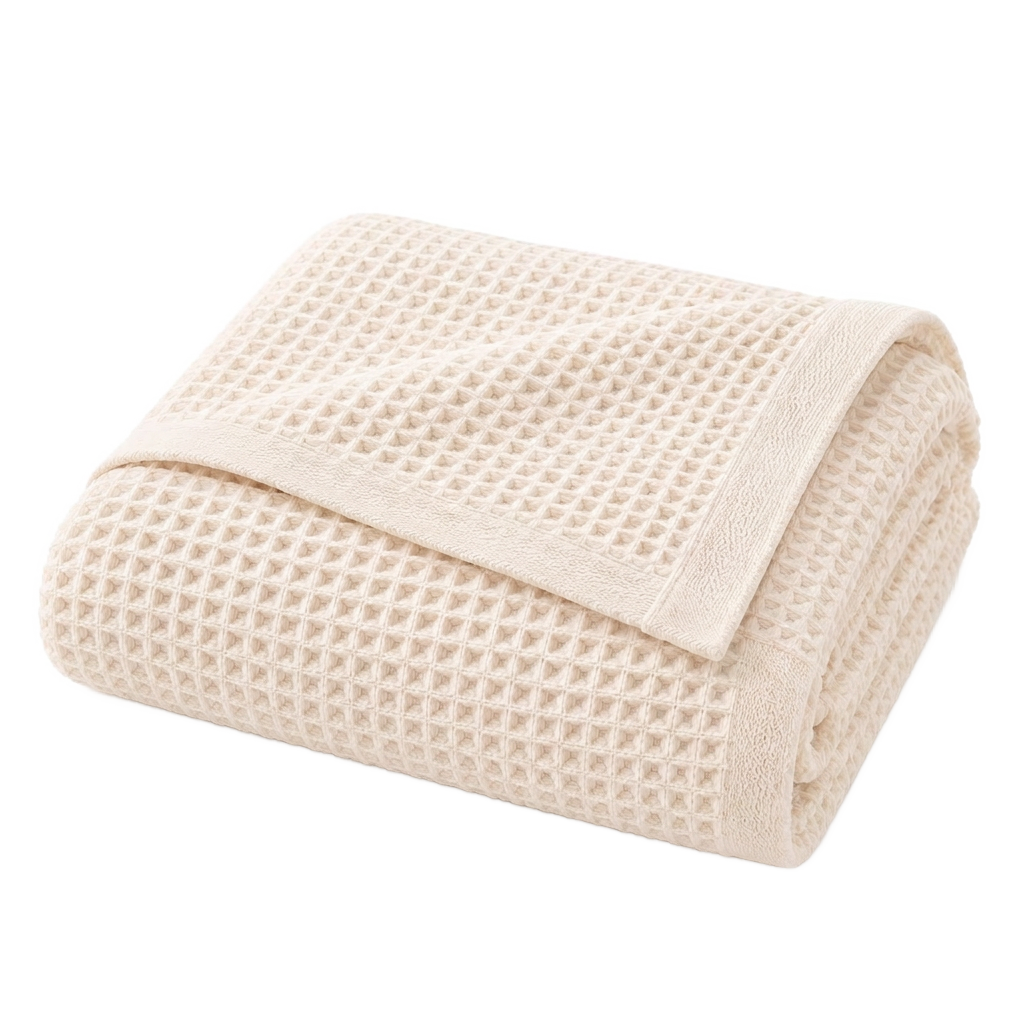
Cotton Waffle Blanket
A fringed edge on a wool throw isn't decoration added after the fact — it's what a loom leaves behind. Before hemming a woven edge became standard practice, the warp threads simply hung loose where the weaving stopped, and someone eventually decided the frayed edge looked better knotted than left raw. Centuries later, fringe survives on premium throws as a deliberate style choice, even though the mills making them today have no technical reason to leave an edge unfinished.
The same factories that produce for houses like Celine and Balenciaga can produce this piece, directly to you
GABI
Make it yours
Material gradeMOQ 50
Colour
Cotton Waffle Blanket
A fringed edge on a wool throw isn't decoration added after the fact — it's what a loom leaves behind. Before hemming a woven edge became standard practice, the warp threads simply hung loose where the weaving stopped, and someone eventually decided the frayed edge looked better knotted than left raw. Centuries later, fringe survives on premium throws as a deliberate style choice, even though the mills making them today have no technical reason to leave an edge unfinished.
The same factories that produce for houses like Celine and Balenciaga can produce this piece, directly to you
GABI
Make it yours
Material gradeMOQ 50
Colour
A fringed edge on a wool throw isn't decoration added after the fact — it's what a loom leaves behind. Before hemming a woven edge became standard practice, the warp threads simply hung loose where the weaving stopped, and someone eventually decided the frayed edge looked better knotted than left raw. Centuries later, fringe survives on premium throws as a deliberate style choice, even though the mills making them today have no technical reason to leave an edge unfinished.
What the Loom Leaves Behind
Fringe began as an unfinished edge, later kept and refined as an intentional design detail rather than a technical necessity.
Pure cashmere is too delicate and expensive for a daily-use throw; wool-cashmere blends trade a little softness for meaningfully better durability and a lower cost, which is why most cashmere throws on the market are blends.
Knitted throws (cable knit, chunky knit) are made on flatbed knitting machines and drape and stretch; woven throws (waffle weave, herringbone) hold a crisper, more structured shape, which matters for a throw meant to be displayed folded rather than draped.
Waffle-weave throws use the same grid-texture construction as waffle robes and towels, chosen for lightweight warm-weather use over a heavier knit or terry throw.
FAQ
A knitted cotton throw (China, 300–500 unit run) lands around $10–18; a wool-cashmere blend throw runs $28–45, driven by the cashmere content percentage.
Pure cashmere is softest but too delicate and expensive for a daily-use hospitality or gifting throw; a wool-cashmere blend (commonly around 70/30) holds up to more handling and costs meaningfully less while keeping most of the soft hand-feel.
Knitted throws are made on flatbed knitting machines and drape loosely with some stretch; woven throws hold a crisper, more structured shape, which matters if the throw is meant to be displayed folded on furniture rather than draped.
Typically 300–500 units per colorway, since both knitting and weaving require a yarn or dye-lot minimum to run economically.
Hand-knotted fringe adds a manual finishing step and labor cost over a machine-hemmed edge; specify which you want, since "fringed throw" alone doesn't indicate whether the fringe is hand-finished or machine-simulated.
Yes — cashmere pills and mats with the frequent handling and cleaning that hospitality textiles see, and it typically requires professional cleaning rather than standard commercial laundering, which is worth flagging to buyers before they commit to pure cashmere at scale.
Throws generally fall under HS 6301 (blankets and travelling rugs), with subheadings splitting by fiber content — wool, cotton, or synthetic. Confirm per SKU, since fiber blend affects the applicable duty rate.


