
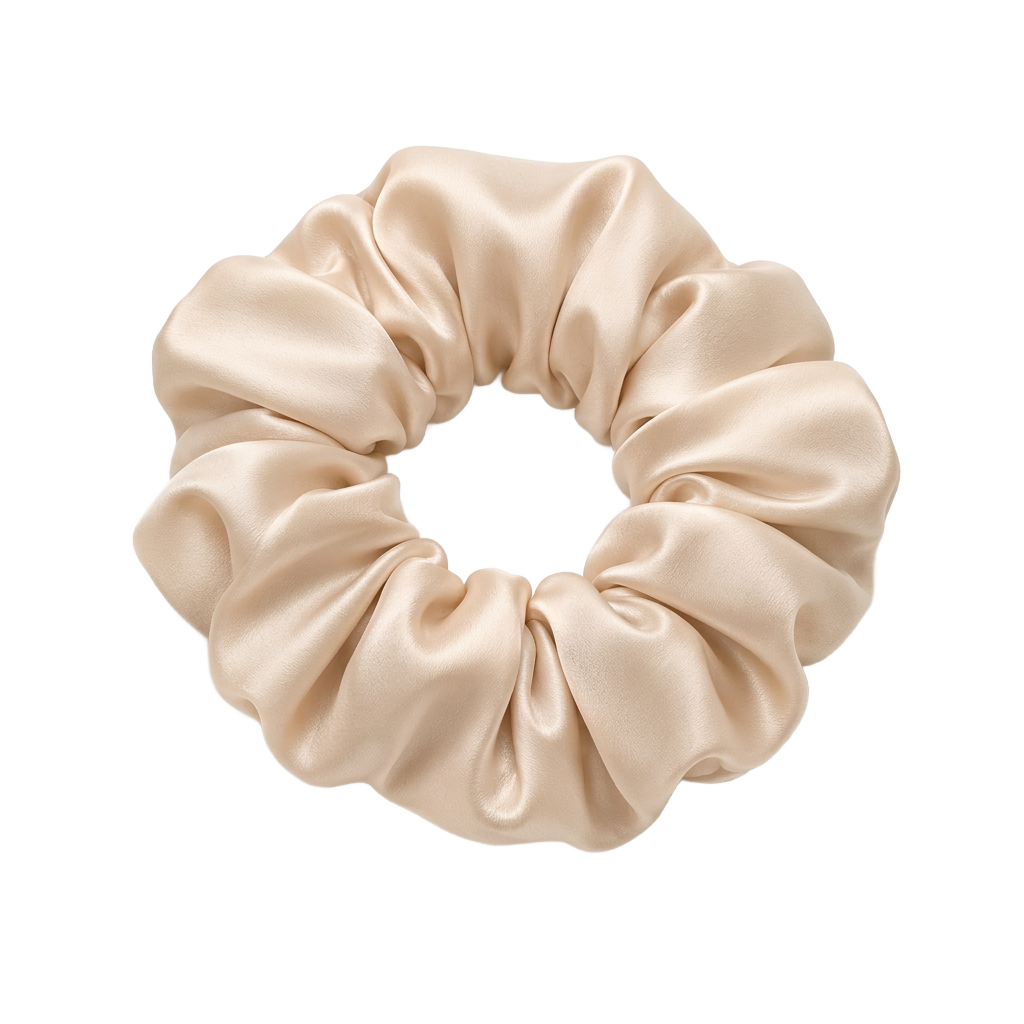
Scrunchie
Rommy Revson invented the scrunchie in 1986 because standard elastic hair ties were snapping and damaging her hair, and patented the simple fix: a plain elastic band sewn inside a tube of fabric. The scrunchie fell out of fashion almost entirely by the early 2000s, dismissed as dated, before a wave of 1980s and '90s nostalgia brought it back as a deliberate style statement rather than a purely practical hair tool.
The same factories that produce for houses like Celine and Balenciaga can produce this piece, directly to you
GABI
Make it yours
Material gradeMOQ 50
Colour
Scrunchie
Rommy Revson invented the scrunchie in 1986 because standard elastic hair ties were snapping and damaging her hair, and patented the simple fix: a plain elastic band sewn inside a tube of fabric. The scrunchie fell out of fashion almost entirely by the early 2000s, dismissed as dated, before a wave of 1980s and '90s nostalgia brought it back as a deliberate style statement rather than a purely practical hair tool.
The same factories that produce for houses like Celine and Balenciaga can produce this piece, directly to you
GABI
Make it yours
Material gradeMOQ 50
Colour
Rommy Revson invented the scrunchie in 1986 because standard elastic hair ties were snapping and damaging her hair, and patented the simple fix: a plain elastic band sewn inside a tube of fabric. The scrunchie fell out of fashion almost entirely by the early 2000s, dismissed as dated, before a wave of 1980s and '90s nostalgia brought it back as a deliberate style statement rather than a purely practical hair tool.
A Patent for Not Damaging Hair
Rommy Revson's 1986 invention, aimed at solving hair breakage rather than creating a fashion object.
A scrunchie is built by sewing a plain elastic loop inside a fabric tube cut on the bias for stretch, then gathering the fabric along the elastic — the gathering is what creates the signature ruffled, "scrunched" look.
Satin and silk scrunchies reduce friction against hair, marketed for reducing breakage and creasing, especially for fine or textured hair; cotton or velvet scrunchies are chosen mainly for visual and textural effect rather than hair care claims.
The elastic core, not the fabric shell, is typically what wears out first — higher-quality elastic retains its stretch through significantly more wash cycles than a low-cost elastic core.
FAQ
A cotton or polyester scrunchie (China, 500-unit run) lands around $0.60–1.20; a satin or silk scrunchie runs $1.50–3, driven by the fabric cost and often a higher-grade elastic paired with it.
Satin or silk for a hair-care-focused claim (less friction, less breakage); cotton for a casual, everyday feel at lower cost; velvet for a textured, seasonal look. State the fabric explicitly, as "scrunchie" alone doesn't specify it.
Cutting the fabric tube at an angle to the grain gives it natural stretch and drape, which is what allows the fabric to gather smoothly around the elastic into the signature scrunched shape. A straight-grain cut would gather stiffly and unevenly.
Typically 500–1,000 units per fabric and colorway, since scrunchies are a low-cost item where factories need higher volume to make a production run worthwhile.
Wider, higher-tension elastic holds hair more securely and lasts through more wash and wear cycles; specify both width and elastic grade, since a thin or low-grade elastic is the most common point of failure in a cheaply made scrunchie.
It's a real, testable material property — a smoother fiber surface creates less friction against hair than a rougher cotton weave, which does reduce mechanical damage and creasing. It's a legitimate spec difference, not purely a marketing claim.
Scrunchies generally fall under HS 9615 (combs, hair-slides, and similar articles) or occasionally HS 6117 depending on how the classification authority treats the elastic-and-fabric construction. Confirm with a customs broker, as this is a category with some classification variation.
