
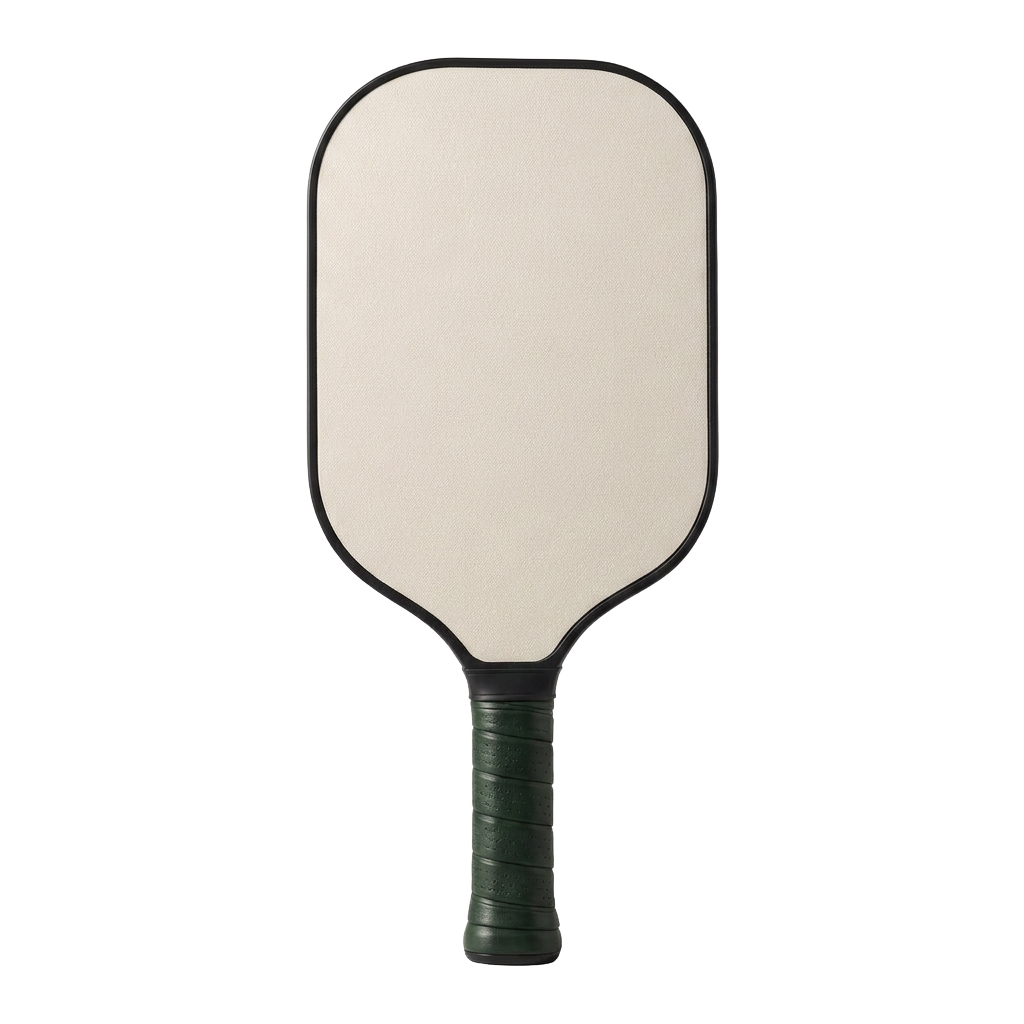
Pickleball Paddle
Three dads on Bainbridge Island had bored kids, a badminton net, and no shuttlecocks. They improvised with ping-pong paddles and a perforated plastic ball meant for backyard wiffle games. That was the summer of 1965. Fifty-eight years later, pickleball was the fastest-growing sport in America for three consecutive years running, and the paddle — still, at its core, an oversized ping-pong bat — had become a $50–200 carbon-fiber composite product with its own materials science.
The same factories that produce for houses like Celine and Balenciaga can produce this piece, directly to you
GABI
Make it yours
Material gradeMOQ 50
Colour
Pickleball Paddle
Three dads on Bainbridge Island had bored kids, a badminton net, and no shuttlecocks. They improvised with ping-pong paddles and a perforated plastic ball meant for backyard wiffle games. That was the summer of 1965. Fifty-eight years later, pickleball was the fastest-growing sport in America for three consecutive years running, and the paddle — still, at its core, an oversized ping-pong bat — had become a $50–200 carbon-fiber composite product with its own materials science.
The same factories that produce for houses like Celine and Balenciaga can produce this piece, directly to you
GABI
Make it yours
Material gradeMOQ 50
Colour
Three dads on Bainbridge Island had bored kids, a badminton net, and no shuttlecocks. They improvised with ping-pong paddles and a perforated plastic ball meant for backyard wiffle games. That was the summer of 1965. Fifty-eight years later, pickleball was the fastest-growing sport in America for three consecutive years running, and the paddle — still, at its core, an oversized ping-pong bat — had become a $50–200 carbon-fiber composite product with its own materials science.
Three Dads, a Bored Summer, and a Ball with Holes
Pickleball was invented in the summer of 1965 by Joel Pritchard, Bill Bell, and Barney McCallum, three fathers on Bainbridge Island, Washington, whose families' badminton game was missing shuttlecocks. They lowered the net, improvised paddles from plywood, and used a perforated plastic ball designed for children's games — the same wiffle-style construction that gives the modern pickleball its low bounce and wind resistance. The name's origin is disputed: one account credits "pickle boat," a rowing term for a crew of leftover oarsmen; another says it was named after the family dog, Pickles, who chased stray balls.
The game stayed a regional novelty for decades, formalized with a rulebook in 1984 under the USA Pickleball Association, but its growth was slow and largely confined to retirement communities in the Pacific Northwest and Florida, where the smaller court and lighter paddle made it accessible to older players transitioning from tennis.
Paddle construction is where the category's manufacturing story lives: early paddles were solid wood, cheap and durable but heavy and lacking any "pop." The shift to composite construction — a honeycomb polymer core (typically Nomex, aluminum, or polypropylene) sandwiched between fiberglass or carbon-fiber face sheets — arrived from the broader composites industry and transformed paddle weight, power, and price simultaneously. A modern competitive paddle weighs roughly half what a 1990s wood paddle did.
The pandemic-era growth (2020–2023) was driven by exactly what the original inventors stumbled onto: a low barrier to entry, a court a third the size of a tennis court, and equipment cheap enough to try before committing. The Sports & Fitness Industry Association named pickleball America's fastest-growing sport for three straight years in that period, and paddle and ball manufacturing — previously a niche supplying a few thousand courts — scaled into a mainstream sporting goods category almost overnight.
FAQ
A composite paddle with fiberglass face and polypropylene honeycomb core (China, 300-unit run) lands around $8–14; carbon-fiber face paddles targeting competitive players run $15–25 landed, with the face material and core density being the main cost drivers.
Composite paddle production requires a factory with honeycomb core lamination and edge-guard molding capability — similar tooling to snowboard or surfboard composite manufacturing, not a standard sporting-goods or wood-shop factory. Confirm the factory has produced racket-sport paddles specifically, not just generic composite panels.
Injection-molded perforated balls typically require 1,000–3,000 units minimum per color, since the mold tooling for the hole pattern is the main upfront cost; outdoor (harder, smaller holes) and indoor (softer, larger holes) balls use different molds and are not interchangeable specs.
Only for tournament play — recreational paddles can be sold without approval, but claiming "USAPA approved" requires the specific paddle model to pass USA Pickleball's official testing (surface roughness, thickness, and dimension limits) and appear on their approved equipment list.
Outdoor balls have smaller, more numerous holes (typically 40) and harder plastic to resist wind and asphalt abrasion; indoor balls have fewer, larger holes (26) and softer plastic tuned for gymnasium floors. Specifying the wrong one for the intended market is a common sourcing mistake.
Nomex honeycomb (an aramid paper, the same material used in aerospace composites) gives the loudest "pop" and most power but is being phased out of competitive play by USA Pickleball for noise complaints in residential areas; polypropylene cores are quieter and now the standard for most new paddle lines.
Paddles typically fall under HS 9506.99 (other sports equipment, not elsewhere specified) since pickleball isn't yet broken out as its own tariff line in most schedules; balls generally classify under the same code as other perforated plastic sports balls — confirm with a customs broker, as this is a newer category still settling into standard classification practice.


