
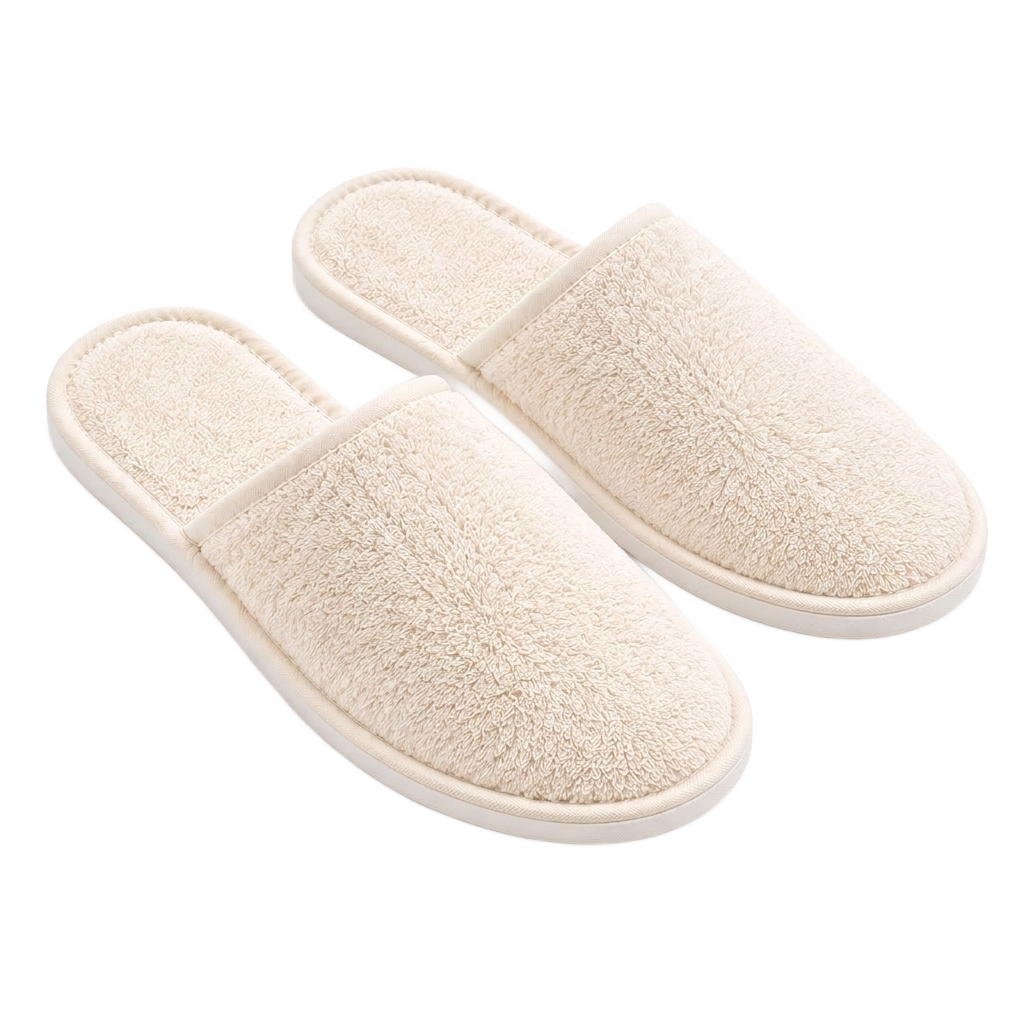
Closed-Toe Terry Slippers
Japanese ryokan inns have offered guests a pair of slippers at the threshold for centuries — not as a luxury touch, but as a practical boundary between outdoor street dirt and the inn's shared floors. Western hotels borrowed the gesture without the original logic, turning the slipper into a one-time-use amenity rather than a barefoot-culture necessity. The terrycloth spa slipper folded in a hotel bathroom today keeps the form of that custom long after most of its original purpose disappeared.
The same factories that produce for houses like Celine and Balenciaga can produce this piece, directly to you
GABI
Make it yours
Material gradeMOQ 50
Colour
Closed-Toe Terry Slippers
Japanese ryokan inns have offered guests a pair of slippers at the threshold for centuries — not as a luxury touch, but as a practical boundary between outdoor street dirt and the inn's shared floors. Western hotels borrowed the gesture without the original logic, turning the slipper into a one-time-use amenity rather than a barefoot-culture necessity. The terrycloth spa slipper folded in a hotel bathroom today keeps the form of that custom long after most of its original purpose disappeared.
The same factories that produce for houses like Celine and Balenciaga can produce this piece, directly to you
GABI
Make it yours
Material gradeMOQ 50
Colour
Japanese ryokan inns have offered guests a pair of slippers at the threshold for centuries — not as a luxury touch, but as a practical boundary between outdoor street dirt and the inn's shared floors. Western hotels borrowed the gesture without the original logic, turning the slipper into a one-time-use amenity rather than a barefoot-culture necessity. The terrycloth spa slipper folded in a hotel bathroom today keeps the form of that custom long after most of its original purpose disappeared.
Borrowed From the Ryokan
The practice of offering guests slippers at the door predates Western hospitality by centuries, originally functional rather than decorative.
Closed-toe slippers use more upper material and offer more warmth and durability; open-toe slippers use roughly a fifth less material and are preferred for spa and pedicure settings where toe access matters.
Waffle-weave slippers are lighter and more breathable, suited to warm-climate spas; terry slippers are plusher and warmer, suited to cooler-climate hotels.
Soles are typically EVA foam for cushioning and slip resistance on wet spa floors, versus a non-woven fabric sole used on lower-cost, single-use amenity slippers.
FAQ
A basic open-toe terry slipper with a non-woven sole (China, 500-unit run) lands around $1–2; a closed-toe waffle or terry slipper with an EVA foam sole runs $2.50–4.50, driven by the extra material and sole construction.
Closed-toe for durability, warmth, and multi-use hotel programs; open-toe for spa and pedicure settings where toe access matters, and for lower per-unit cost on single-use amenity programs.
Typically 500–1,000 pairs per size and material combination, since the upper fabric and sole are both ordered in bulk rolls or sheets that need a minimum run to be cost-effective.
Waffle is lighter and more breathable, suited to warm-climate resorts and spas; terry is plusher and warmer, suited to cooler-climate hotels where guests want more coverage and cushioning.
EVA foam is the standard choice for cushioning and slip resistance in wet environments; non-woven fabric soles are cheaper but offer less grip and are typically reserved for single-use, dry-environment amenity programs.
Amenity-program slippers are usually specified for single or short-stay use, which allows thinner, cheaper materials; resort or spa slippers meant for repeated multi-day use need sturdier soles and uppers, which raises the per-unit cost.
Textile-upper slippers generally fall under HS 6405 (footwear with uppers of other materials) or HS 6404 depending on sole material. Confirm per SKU, since sole composition affects the classification.


