
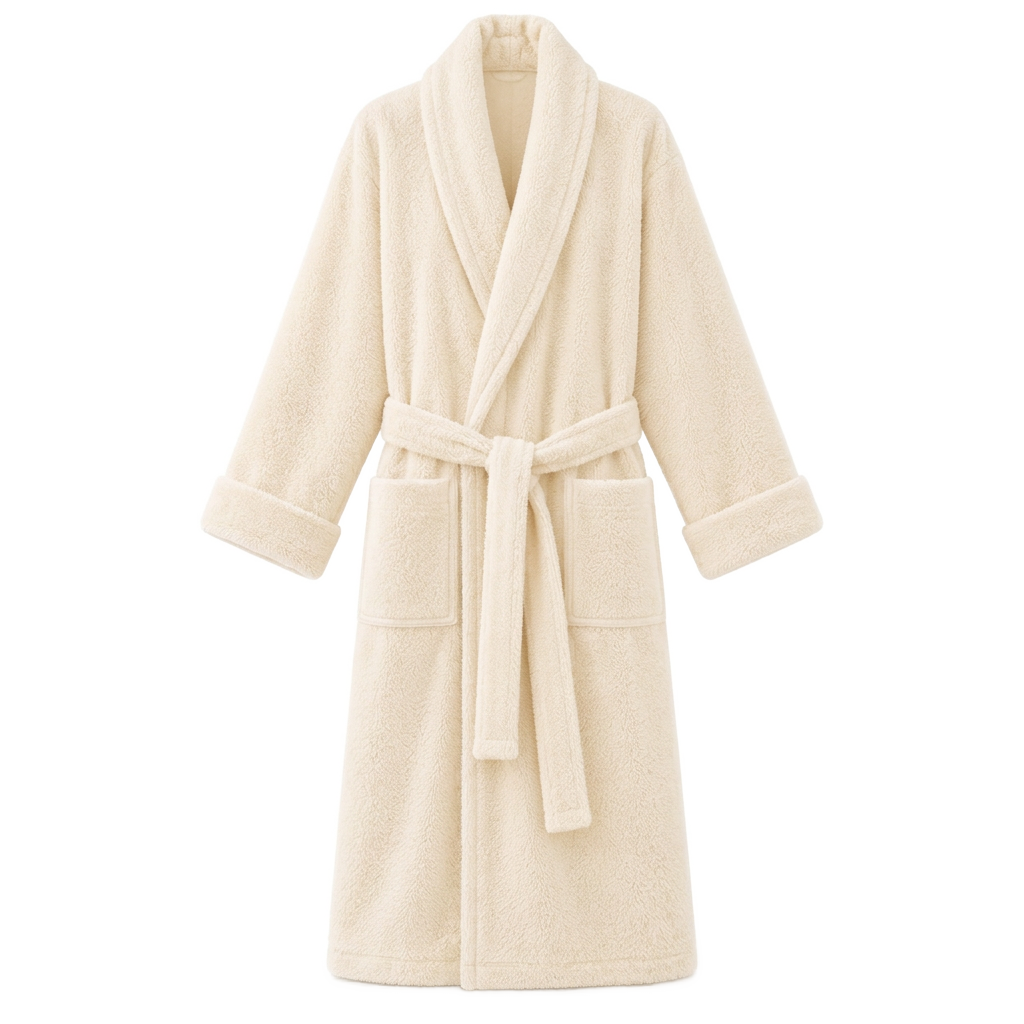
Shawl-Collar Bathrobe
When Japanese trade goods flooded into Europe after the 1850s reopening of Japan, Western audiences didn't just buy kimono as souvenirs — they adapted the loose, unstructured cut into a new garment entirely: the dressing gown, and later, the bathrobe. The shawl collar and belted waist that define a Western bathrobe today are a European tailoring translation of a garment that, in Japan, was never meant to be cinched at all. A century and a half later, the two lineages, tailored and unstructured, still exist side by side on the same hotel closet hook.
The same factories that produce for houses like Celine and Balenciaga can produce this piece, directly to you
GABI
Make it yours
Material gradeMOQ 50
Colour
Shawl-Collar Bathrobe
When Japanese trade goods flooded into Europe after the 1850s reopening of Japan, Western audiences didn't just buy kimono as souvenirs — they adapted the loose, unstructured cut into a new garment entirely: the dressing gown, and later, the bathrobe. The shawl collar and belted waist that define a Western bathrobe today are a European tailoring translation of a garment that, in Japan, was never meant to be cinched at all. A century and a half later, the two lineages, tailored and unstructured, still exist side by side on the same hotel closet hook.
The same factories that produce for houses like Celine and Balenciaga can produce this piece, directly to you
GABI
Make it yours
Material gradeMOQ 50
Colour
When Japanese trade goods flooded into Europe after the 1850s reopening of Japan, Western audiences didn't just buy kimono as souvenirs — they adapted the loose, unstructured cut into a new garment entirely: the dressing gown, and later, the bathrobe. The shawl collar and belted waist that define a Western bathrobe today are a European tailoring translation of a garment that, in Japan, was never meant to be cinched at all. A century and a half later, the two lineages, tailored and unstructured, still exist side by side on the same hotel closet hook.
A Kimono, Reinterpreted
European fashion houses adapted the kimono's flat, unstructured cut through the Japonisme movement of the 1860s, adding a shawl collar and belt that the original garment never had.
Terry, waffle, and microfiber are the three standard robe fabrics: terry is the heaviest and most absorbent, waffle is lighter and faster-drying thanks to its grid texture, and microfiber is the cheapest and quickest to dry but least plush.
A hood adds a shaped pattern piece and extra seam that a collarless robe skips — a small but real assembly cost, justified in spa use where it protects hair after treatments.
Belted robes offer a fitted, structured silhouette; open kimono-style robes skip the belt closure point entirely, which makes a single size genuinely fit a wider range of bodies.
FAQ
A standard waffle-weave robe (China, 300–500 unit run) lands around $12–20; a plush terry robe runs $22–35; a hooded or shawl-collar robe with heavier terry adds $5–10 for the extra pattern pieces and fabric weight.
Terry for maximum absorbency and a plush hotel feel; waffle for a lighter robe that dries faster, suited to warm climates and spas; microfiber for the lowest cost and fastest dry time, at the expense of plushness.
Typically 300–500 units per size and colorway, since dyeing and fabric are ordered by the roll or dye lot, similar to other cut-and-sew apparel.
A hood adds its own shaped panel and seam, a real assembly step a collarless robe skips; a shawl-collar robe needs a structured, often interfaced collar piece for the rolled lapel look. Both cost more than a simple collarless or kimono-style robe.
Open kimono-style robes skip the belt closure point, so a single size drapes acceptably on a wider range of bodies; belted robes give a more tailored, structured fit but need more precise sizing.
Requirements vary by market and hotel brand standard rather than being universally mandatory, but many commercial hospitality contracts require flame-retardant treatment or inherently flame-resistant fiber content. Confirm the buyer's specific compliance requirement before sourcing.
Robes generally fall under HS 6108 (women's) or HS 6107 (men's) for knitted/crocheted robes, with woven equivalents under HS 6208/6207. Confirm per SKU based on knit vs. woven construction and gender classification.


