
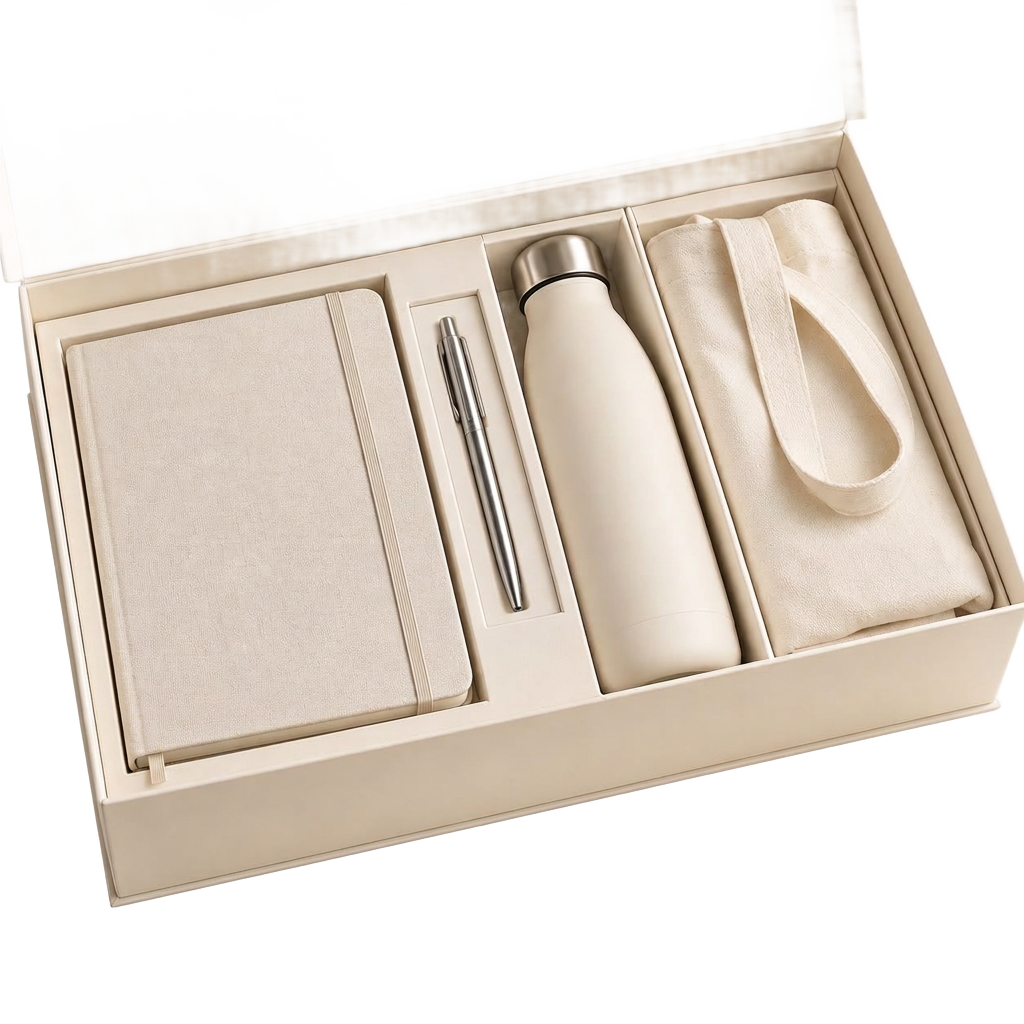
Employee Welcome Kit
A Fortnum & Mason hamper and a startup's employee onboarding box solve the exact same logistical problem two centuries apart: how do you present several separately made things as one considered gift? The Victorian hamper bundled preserves, tea, and biscuits from different suppliers into a single basket; today's client gift set, event swag box, or welcome kit bundles a notebook, a water bottle, and a piece of branded apparel from different factories into a single shipment. The occasion changes, client relationship, product launch, new hire, but the underlying challenge, coordinating unrelated production lines into one coherent unboxing, doesn't.
The same factories that produce for houses like Celine and Balenciaga can produce this piece, directly to you
GABI
Make it yours
Material gradeMOQ 50
Colour
Employee Welcome Kit
A Fortnum & Mason hamper and a startup's employee onboarding box solve the exact same logistical problem two centuries apart: how do you present several separately made things as one considered gift? The Victorian hamper bundled preserves, tea, and biscuits from different suppliers into a single basket; today's client gift set, event swag box, or welcome kit bundles a notebook, a water bottle, and a piece of branded apparel from different factories into a single shipment. The occasion changes, client relationship, product launch, new hire, but the underlying challenge, coordinating unrelated production lines into one coherent unboxing, doesn't.
The same factories that produce for houses like Celine and Balenciaga can produce this piece, directly to you
GABI
Make it yours
Material gradeMOQ 50
Colour
A Fortnum & Mason hamper and a startup's employee onboarding box solve the exact same logistical problem two centuries apart: how do you present several separately made things as one considered gift? The Victorian hamper bundled preserves, tea, and biscuits from different suppliers into a single basket; today's client gift set, event swag box, or welcome kit bundles a notebook, a water bottle, and a piece of branded apparel from different factories into a single shipment. The occasion changes, client relationship, product launch, new hire, but the underlying challenge, coordinating unrelated production lines into one coherent unboxing, doesn't.
The Hamper Logic
Curated multi-item gifting predates the corporate world by centuries; the occasion changes but the coordination challenge is the same.
Each item in a gift set typically comes from a different production line or factory entirely, so the hardest part of building any set, client, event, or employee, isn't manufacturing any single component but coordinating all of them to arrive at one facility for final packing on schedule.
The occasion shapes the curation logic more than the packaging does: client and event gifts skew toward memorability tied to a specific moment (a launch, a conference), often as one-off or low-repeat runs, while employee gifts skew toward practical utility and consistency, since they are issued repeatedly to a rolling population over time and benefit from a standing, repeatable supply chain rather than a one-off curated batch.
A well-built set balances items with meaningfully different price points and functions, something useful, something branded, something consumable, regardless of occasion, since redundant components read as filler rather than a considered selection.
FAQ
Cost is additive across components rather than a single unit price — a basic set (branded notebook, pen, small consumable, and packaging) typically lands around $15–30 per set; a premium client or event gift set with higher-end components can run $40–80 or more, driven entirely by which items are included.
Coordinating delivery timing across multiple factories, each producing a different component, so everything arrives at one facility for final assembly and packing on schedule. A delay in any single component holds up the entire set, regardless of what occasion it's for.
Client and event gifts lean toward memorability and brand impression tied to a specific moment, often justifying a higher-end, one-off curated selection; employee gifts lean toward practical, repeatable utility since they are issued continuously to new people over time, favoring consistency and a standing supply chain over novelty.
Yes — each component (a notebook, a water bottle, a piece of apparel) carries its own manufacturing MOQ independently, and the set's overall minimum is effectively set by whichever component has the highest MOQ among those chosen.
Usually separately — packaging (the outer box, inserts, tissue) is a converting and finishing trade distinct from manufacturing garments, drinkware, or stationery, so it's rarely efficient to source both from one factory.
Plan for the longest individual component's lead time, plus buffer time for shipping all components to one assembly point and final packing — meaningfully longer than sourcing any single item in the set alone.
Components are generally declared individually by their own HS codes rather than as one combined "gift set" code, since customs classification follows the material and function of each item, not the bundling. Confirm with a customs broker for sets crossing multiple material categories.


