
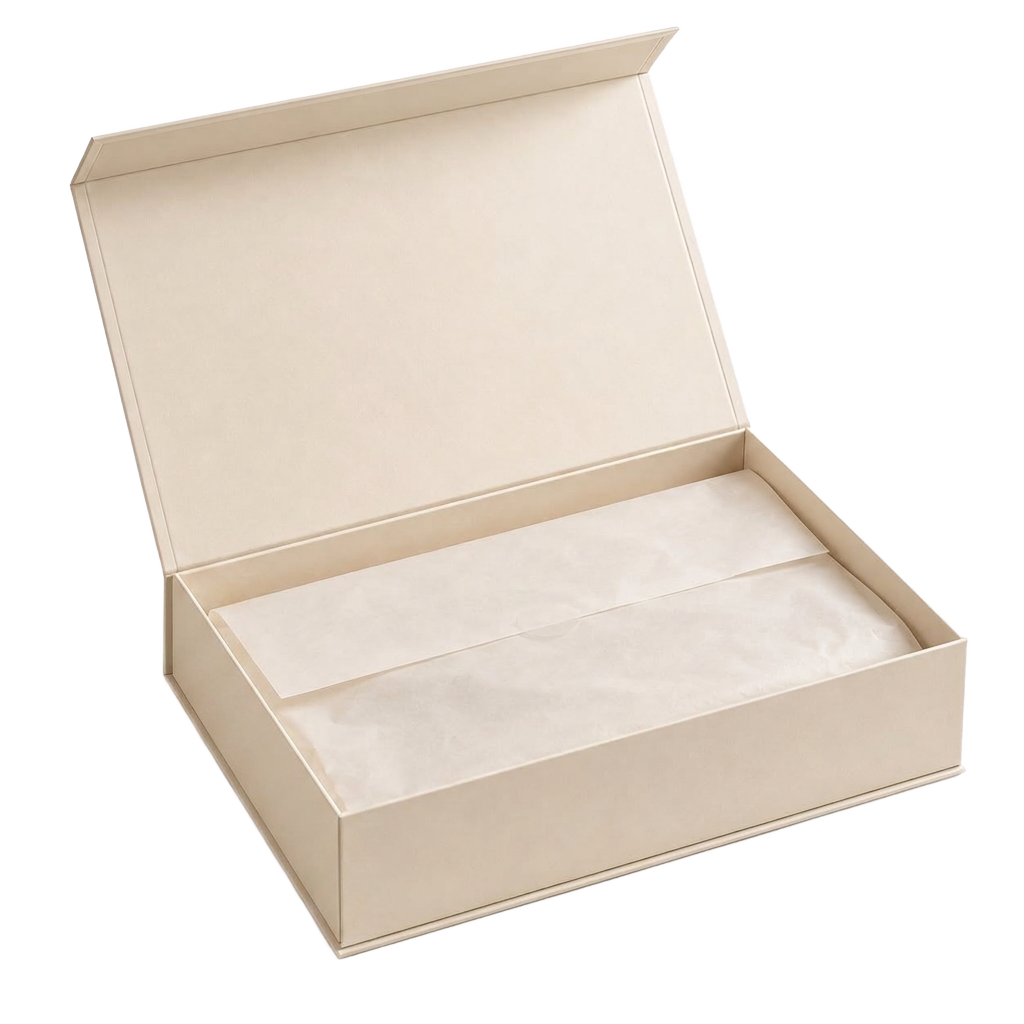
Magnetic Gift Box
The rigid two-piece gift box, a base and a separate lid, is old enough that Victorian-era hat boxes used the same basic construction. The drawer-style box, which slides open like a matchbox, is a French perfumery format that predates modern branding by a century, revived in recent decades as a "premium unboxing" signature. The magnetic-closure box is the newest of the three, borrowing a hidden-magnet mechanism from portfolio and folder hardware to close a rigid box without a separate lid, ribbon, or tuck-in flap at all.
The same factories that produce for houses like Celine and Balenciaga can produce this piece, directly to you
GABI
Make it yours
Material gradeMOQ 50
Colour
Magnetic Gift Box
The rigid two-piece gift box, a base and a separate lid, is old enough that Victorian-era hat boxes used the same basic construction. The drawer-style box, which slides open like a matchbox, is a French perfumery format that predates modern branding by a century, revived in recent decades as a "premium unboxing" signature. The magnetic-closure box is the newest of the three, borrowing a hidden-magnet mechanism from portfolio and folder hardware to close a rigid box without a separate lid, ribbon, or tuck-in flap at all.
The same factories that produce for houses like Celine and Balenciaga can produce this piece, directly to you
GABI
Make it yours
Material gradeMOQ 50
Colour
The rigid two-piece gift box, a base and a separate lid, is old enough that Victorian-era hat boxes used the same basic construction. The drawer-style box, which slides open like a matchbox, is a French perfumery format that predates modern branding by a century, revived in recent decades as a "premium unboxing" signature. The magnetic-closure box is the newest of the three, borrowing a hidden-magnet mechanism from portfolio and folder hardware to close a rigid box without a separate lid, ribbon, or tuck-in flap at all.
Three Boxes, Three Eras
Lift-off lid boxes descend from Victorian hat boxes, drawer-style from French perfumery packaging, and magnetic closure from modern portfolio hardware.
Lift-off lid construction is the simplest and cheapest — two separate rigid pieces, base and lid — but the lid detaches entirely during unboxing and can be set down and misplaced.
Drawer-style construction uses a sliding inner tray inside a rigid outer sleeve, requiring tighter tolerances than a lift-off box so the drawer slides smoothly without binding.
Magnetic closure embeds a thin magnet in the lid flap and a matching metal plate in the box body, a small hardware addition that gives a rigid box a satisfying "snap shut" without ribbon or tuck flaps.
FAQ
A lift-off lid box (China, 300–500 unit run) lands around $2–4; a drawer-style box runs $3–6 due to tighter tolerance requirements; a magnetic closure box runs $4–8, driven by the embedded hardware.
Lift-off lid for the lowest cost and simplest use; drawer-style for a premium unboxing moment where the sliding action itself is part of the experience; magnetic closure for the highest-end feel where a clean, ribbon-free close matters.
Rigid boxes are typically built from 1.5–2mm greyboard wrapped in a printed paper or fabric outer layer; thicker board feels more premium and resists crushing better but adds cost and shipping weight.
Typically 300–500 units per size and print design, since both the rigid board wrapping and printing setup carry a fixed cost per design that needs volume to amortize.
Yes — placing the magnet and metal plate accurately requires an assembly step beyond standard box wrapping, which typically adds a small amount to both cost and lead time compared to a lift-off or drawer box.
A poorly toleranced drawer either binds and won't slide smoothly, or fits too loosely and slides open unintentionally during shipping. This is the main quality-control point to check samples for before committing to a full run.
Rigid paperboard gift boxes generally fall under HS 4819 (cartons, boxes, and cases of paper or paperboard). Confirm the specific subheading if the box includes non-paper hardware like magnets, since mixed-material construction can affect classification.


