
Protective Inserts & Dividers
None of the materials that finish a gift box, tissue paper, foam or cardboard inserts, ribbon, and a paper tag, do anything to protect the product on their own. Their entire job is the few seconds between a box opening and the product coming into view, which is exactly why they get specified separately from the box itself: a factory that makes excellent rigid boxes often doesn't touch tissue, ribbon, or inserts at all, since these are a converting and finishing trade, not a box-making one.
The same factories that produce for houses like Celine and Balenciaga can produce this piece, directly to you
GABI
Make it yours
Material gradeMOQ 50
Colour
Protective Inserts & Dividers
None of the materials that finish a gift box, tissue paper, foam or cardboard inserts, ribbon, and a paper tag, do anything to protect the product on their own. Their entire job is the few seconds between a box opening and the product coming into view, which is exactly why they get specified separately from the box itself: a factory that makes excellent rigid boxes often doesn't touch tissue, ribbon, or inserts at all, since these are a converting and finishing trade, not a box-making one.
The same factories that produce for houses like Celine and Balenciaga can produce this piece, directly to you
GABI
Make it yours
Material gradeMOQ 50
Colour
None of the materials that finish a gift box, tissue paper, foam or cardboard inserts, ribbon, and a paper tag, do anything to protect the product on their own. Their entire job is the few seconds between a box opening and the product coming into view, which is exactly why they get specified separately from the box itself: a factory that makes excellent rigid boxes often doesn't touch tissue, ribbon, or inserts at all, since these are a converting and finishing trade, not a box-making one.
The Few Seconds Before the Product Appears
These materials exist entirely for the moment of unboxing, not for structural protection, which is why they are sourced separately from the box.
Tissue paper splits into acid-free (prevents yellowing and degradation over long storage, relevant for delicate textiles or metals) and standard grades, with paper weight affecting how crisply it crinkles and holds a fold for presentation.
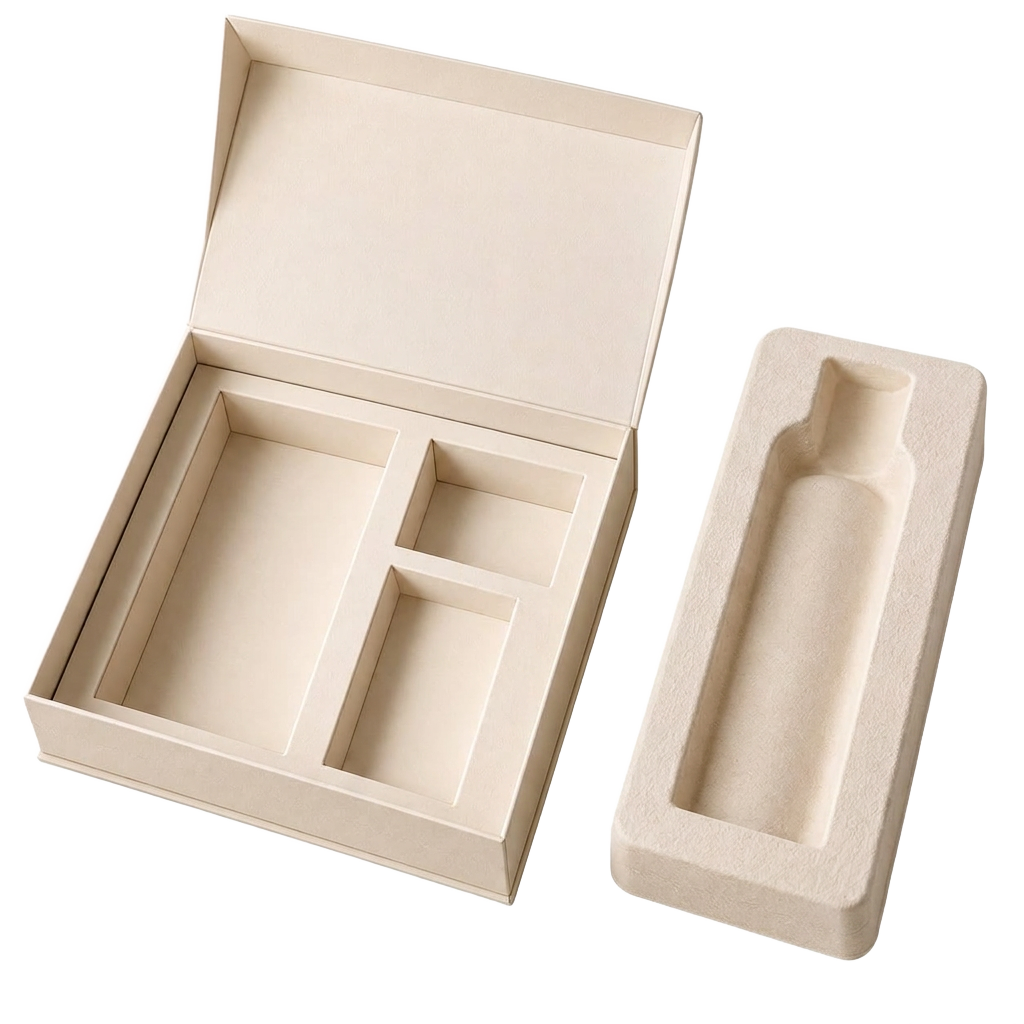
Protective inserts and dividers are either custom die-cut cardboard or molded foam/pulp shaped to hold a specific product firmly in place, a tooling cost that only pays off at volume, or generic foam sheets and pads for lower-volume runs where custom tooling isn't justified.
Ribbon and gift tag sets vary by ribbon material (satin, grosgrain, or paper, each a different texture and cost) and by tag attachment method (string-tied, adhesive, or a die-cut slot).
FAQ
Standard tissue paper (China, bulk run) lands around $0.05–0.15 per sheet; generic foam inserts run $0.50–1.50 per unit; custom die-cut inserts run $1–3 depending on tooling amortization; a ribbon and tag set runs $0.30–0.80 per unit.
Acid-free matters for products stored long-term or sensitive to yellowing and degradation, like fine textiles, silver, or delicate metals; for short-term gifting use where the tissue is discarded quickly, standard tissue is fine and cheaper.
Custom inserts are worth the tooling cost at higher volumes or when a product needs precise, repeatable positioning during shipping (fragile or oddly shaped items); generic foam padding is more cost-effective for lower-volume runs or sturdier products.
Typically 1,000–2,000 units for printed tissue paper or tags, since printing setup on these lightweight materials needs higher volume to be cost-effective; plain, unprinted versions have much lower minimums.
Satin for a smooth, glossy premium look; grosgrain for a textured, ribbed finish that holds a bow shape well; paper ribbon for the lowest cost and a more rustic or eco-positioned presentation.
String-tied for a traditional, handmade look; adhesive for the fastest assembly and lowest cost; a die-cut slot (tag slides onto the ribbon through a cut slot) for a clean look without extra hardware or string.
Tissue paper falls under HS 4802 or 4823 depending on finishing; ribbon falls under HS 5806/5808; printed gift tags fall under HS 4911 (printed matter). Confirm per SKU, as this group spans several different HS chapters.


